



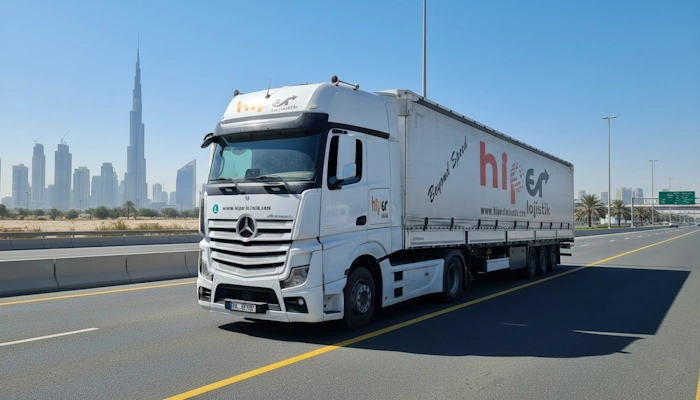
Recent geopolitical developments and increasing uncertainties around the Strait of Hormuz—one of the world’s most critical maritime chokepoints—have accelerated the search for safer and more sustainable logistics solutions. As a result, companies are increasingly shifting away from full dependency on sea freight and exploring alternative transport corridors.
One of the most prominent solutions is the land-based logistics corridor extending from Türkiye through Syria to the Gulf countries.
What is the Syrian Transit Corridor?
The Syrian transit corridor is an alternative logistics route that enables cargo originating from Europe and Türkiye to pass through Türkiye’s border crossings into Syria and then continue toward Gulf countries.
Through this model, shipments can be transported:
- Via Türkiye–Syria border crossings
- Through Middle Eastern inland distribution networks
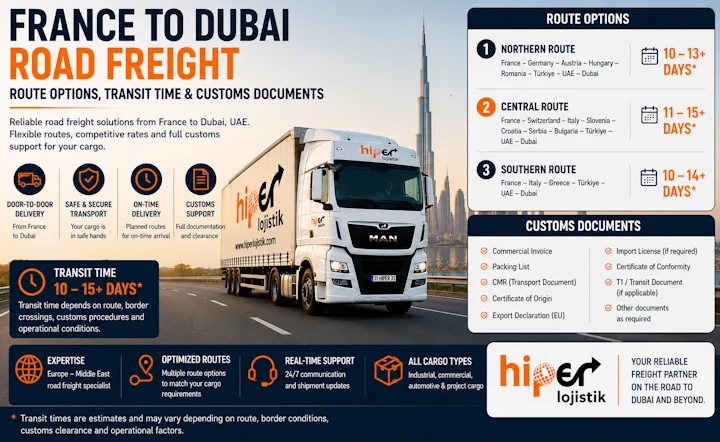
- To destinations such as Qatar, Dubai (UAE), Saudi Arabia, Bahrain, Kuwait, and Oman
in a more controlled and predictable manner.
Why Are Alternative Routes Becoming Essential?
Traditional Europe–GCC logistics has long relied heavily on maritime transport. However, this model increasingly faces challenges such as:
- Port congestion
- Delays and long waiting times
- Geopolitical risks in the Strait of Hormuz
- Fluctuating freight rates
These factors create uncertainty in supply chains, pushing companies to diversify their logistics strategies instead of relying on a single transport model.
Advantages of Road-Based Integrated Transport
The land-based model via Türkiye and Syria offers several key benefits compared to traditional sea freight:
✔ Risk Mitigation
Reduces dependency on maritime chokepoints and minimizes disruption risks.
✔ Time Efficiency
Optimized operations allow deliveries within approximately 12–14 days.
✔ Operational Flexibility
Supports multiple transport modes including partial loads (LTL), full truckload (FTL), and minivan express.
✔ Supply Chain Continuity
Ensures smoother and more predictable logistics planning.
Which Cargo Types Benefit Most?
This corridor is particularly suitable for:
- Time-sensitive shipments
- Regular export operations
- Industries with strict delivery schedules
- Project cargo and heavy transport
With minivan express solutions, cargo from Europe can reach Türkiye within 48–72 hours, followed by fast transit into GCC markets.
How Should Transport Models Be Selected?
Choosing the right transport model is critical for efficiency:
- Full Truckload (FTL): Ideal for large-volume shipments with direct delivery
- Less Than Truckload (LTL): Cost-effective for smaller shipments
- Minivan Express: Best for urgent deliveries
A well-planned combination of these options ensures optimal balance between cost and speed.
A New Approach in Logistics: Flexibility and Multi-Route Planning
Modern logistics strategies are increasingly built on:
- Alternative routing
- Multimodal transport integration
- Risk diversification
- Cost–time optimization
Companies adopting this approach not only improve logistics efficiency but also strengthen their competitive advantage and operational resilience.
Conclusion
For companies operating on the Europe–Türkiye–GCC trade lane, the Syrian land corridor stands out as a strong alternative to traditional sea routes.
Especially for those seeking to reduce dependency on critical maritime passages like the Strait of Hormuz, this model offers:
- More predictable transit times
- Lower operational risks
- Greater logistical flexibility
Similar Services

Comments