



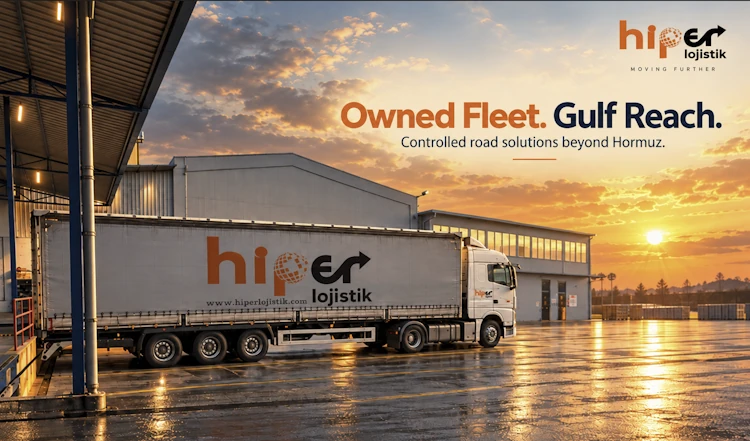
How We Bypassed the Strait of Hormuz: A Logistics Crisis Solution for Europe, Türkiye and the Gulf
An operational case study of Hiper Logistics’ alternative overland freight corridor through Türkiye, Syria, Jordan and Saudi Arabia
Published: October 12, 2026 | Hiper Logistics | Crisis Logistics, Project Cargo and International Road Freight
Executive Summary: When Maritime Supply Chains Were Disrupted, We Reconsidered the Route
The Strait of Hormuz crisis exposed a critical vulnerability in global supply chains: international trade can become heavily dependent on a single maritime chokepoint.
As tensions involving Iran and the United States escalated in 2026, maritime operators faced heightened security concerns, vessel movement restrictions, disrupted sailing schedules and increased uncertainty over cargo delivery.
For importers in the United Arab Emirates, Qatar, Kuwait and Oman, the challenge extended beyond ocean freight rates. Delayed construction materials, industrial machinery, power generation equipment and project cargo could affect entire production and construction schedules.
At Hiper Logistics, our response to the crisis was based on a different question:
What if Gulf-bound cargo did not need to enter the Persian Gulf by sea at all?
Rather than depending exclusively on maritime access through Hormuz, we structured our alternative logistics approach around an overland corridor:
Europe / United States / Türkiye → Türkiye → Syria → Jordan → Saudi Arabia → UAE / Qatar / Kuwait / Oman.
This case study explains the route architecture, border crossings, cargo-handling procedures, risk controls and destination-specific logistics considerations behind that solution.
The corridor is a practical freight-planning alternative, not a guarantee of unrestricted transit. Cargo acceptance, customs permissions, security assessments, vehicle access and insurance must be verified for every movement.
Case study methodology: This article describes Hiper Logistics’ corridor strategy and an operational workflow using representative shipment scenarios. Individual customer identities, delivery results and cost savings are not disclosed or asserted without shipment-level evidence.
1. The Logistics Crisis: How the Strait of Hormuz Disruption Affected Global Trade
The Strait of Hormuz connects the Persian Gulf with the Gulf of Oman and the wider Indian Ocean.
It is one of the most strategically important waterways for international energy transportation and commercial shipping.
During the 2026 Iran-related conflict, escalating threats to commercial vessels caused severe disruption to regional maritime movements.
The consequences extended well beyond the oil and gas sector.
Industrial companies and freight forwarders had to reassess:
- Shipping schedules and vessel availability.
- War-risk insurance and contractual exclusions.
- Uncertain arrival dates for project cargo.
- Port congestion and cargo backlogs.
- The availability of alternative transport modes.
- Land-border transit and customs arrangements.
- The cost of project delays and interrupted production.
For a trading company importing furniture, a shipment delay can cause inventory shortages.
For an engineering contractor importing a generator or foundation-drilling equipment, a delay may interrupt an entire construction phase.
For an energy project, a missing critical component can become a major operational bottleneck.
The underlying problem was not simply finding another shipping company. It was redesigning the supply chain to reduce dependence on a disrupted maritime corridor.
2. The Case: A Time-Sensitive Industrial Shipment Bound for the Gulf
Consider a representative industrial cargo shipment originating in Central Europe and destined for a Gulf construction project.
The cargo consists of:
Diesel generators — Heavy-duty lifting, vibration control and secure lashing
Power-generation equipment — Moisture protection and component identification
Construction machinery — Loading-ramp, axle-load and equipment-clearance checks
Foundation drilling accessories — Weight-distribution and securing plans
Steel components — Bundling, restraint and unloading sequencing
Control panels — Shock protection and weather-resistant packaging
The initial shipping strategy relies on conventional sea freight.
However, the deteriorating security situation around Hormuz introduces uncertainty into the planned arrival date.
The operational problem
The consignee requires the equipment to reach the project site without unnecessary cargo damage, excessive handling or uncontrolled customs delays.
Three operational questions must be resolved:
- Can the cargo reach the Gulf without transiting the Strait of Hormuz?
- Can the transport plan accommodate standard and oversized equipment?
- Can each border, transfer point and delivery stage be controlled and documented?
The Hiper Logistics solution
We evaluate an overland transport chain through Türkiye, Syria, Jordan and Saudi Arabia, followed by country-specific delivery branches.
Instead of treating the shipment as one uninterrupted truck movement, we manage it as a sequence of connected transport and customs operations.
This distinction is particularly important in regional corridors where a trailer, truck, driver or cargo unit may need to change at an international border.
3. The Alternative Corridor: Europe–Türkiye–Syria–Jordan–Saudi Arabia
The fundamental route structure is:
European origin → Türkiye → Cilvegözü / Bab al-Hawa → Syria → Nassib / Jaber → Jordan → Al-Omari / Al-Hadithah → Saudi Arabia → Gulf destination.
For cargo departing from Germany, the Netherlands, Belgium, France, Italy or other European industrial markets, the route to Türkiye may involve European Union and Balkan road networks.
For cargo originating in the United States, the international origin leg can be organized by ocean freight to a suitable Mediterranean or Turkish port, followed by overland forwarding.
American-origin freight does not automatically need to enter the Persian Gulf. It may instead be discharged in Türkiye or another suitable Mediterranean gateway, subject to vessel schedules, port acceptance and export-control requirements.
Türkiye therefore becomes an important connecting point between European road networks, Mediterranean maritime gateways and the Middle Eastern land corridor.
Principal border crossings
Europe → Türkiye — Border crossing: Kapıkule / Kapitan Andreevo or another authorized entry. Operational function: European road transit into Türkiye
Türkiye → Syria — Border crossing: Cilvegözü / Bab al-Hawa. Operational function: Entry into the Syrian corridor
Syria → Jordan — Border crossing: Nassib / Jaber. Operational function: Syrian exit and Jordanian entry
Jordan → Saudi Arabia — Border crossing: Al-Omari / Al-Hadithah. Operational function: Entry into Saudi Arabia
Saudi Arabia → UAE — Border crossing: Al Batha / Al Ghuwaifat. Operational function: UAE overland access
Saudi Arabia → Qatar — Border crossing: Salwa / Abu Samra. Operational function: Qatar overland access
Saudi Arabia → Kuwait — Border crossing: Al Khafji / Al Nuwaiseeb. Operational function: Kuwait overland access
Saudi Arabia → Oman — Border crossing: Rub al Khali / Empty Quarter crossing. Operational function: Direct Saudi–Oman access, subject to routing approval
Other recognized crossings may be evaluated if operational, legally suitable and accepted for the specific cargo category.
Border crossing status, commercial transit rights and vehicle movement permissions must be reconfirmed before dispatch.
4. Türkiye to Syria: The First Critical Transition
Türkiye is a strategic consolidation and forwarding point for cargo arriving from Europe and international ports.
Depending on the shipment, freight may be collected from factories, loaded at Turkish logistics facilities or transferred from ocean containers into road vehicles.
For the southern corridor, Cilvegözü in Hatay connects with Bab al-Hawa on the Syrian side.
From there, the general inland direction is:
Bab al-Hawa → Aleppo → Hama / Homs corridor → Damascus → Nassib.
The precise route must reflect local road conditions, security advisories, vehicle restrictions and customs authorization.
Why controlled cargo transfer matters
A key feature of the transport model is the ability to organize equipment changes where necessary.
If a foreign-registered truck cannot continue through a particular segment, the freight may need to be transferred to an authorized vehicle.
For example:
- The original truck arrives at an approved transfer location.
- The receiving vehicle and transport documents are verified.
- Cargo condition is photographed before handling.
- An appropriate crane, forklift or loading system is assigned.
- The cargo is transferred under supervision.
- Weight distribution and cargo securing are checked.
- Updated vehicle and customs documents are prepared.
- The next transport stage begins only after clearance.
For project cargo, every additional lifting operation introduces exposure to damage.
Therefore, our preferred engineering principle is to minimize unnecessary cargo handling while complying with border and vehicle requirements.
Where an approved trailer or load-unit transfer is feasible, it may be preferable to unloading and reloading the commodity itself.
5. Syria to Jordan: The Nassib–Jaber Gateway
The Nassib–Jaber crossing is a principal land connection between Syria and Jordan.
It provides the geographic link required to continue Gulf-bound freight southward.
Once the shipment approaches this crossing, the operational team must coordinate both sides of the border.
The required procedures may include transit declarations, cargo inspections, vehicle documentation, customs guarantees and the acceptance of the next transport vehicle.
Our process control approach
Before the cargo reaches Nassib–Jaber, the operations team reviews:
- Commercial invoice and packing list.
- Cargo description and HS classification.
- Gross weight and package dimensions.
- Transport and transit documentation.
- Driver and vehicle permissions.
- Cargo insurance and territorial coverage.
- Border broker instructions.
- Expected customs inspection and transfer requirements.
The goal is to identify missing documentation before the truck reaches the border.
This does not eliminate customs delays, but it reduces avoidable uncertainty.
6. Jordan to Saudi Arabia: The Al-Omari–Al-Hadithah Crossing
After entering Jordan, cargo continues via the Jordanian transit road network toward the Saudi border.
The main corridor uses Al-Omari on the Jordanian side and Al-Hadithah on the Saudi side.
This crossing is particularly important because Saudi Arabia becomes the central distribution territory for multiple Gulf destinations.
From Saudi Arabia, road freight can branch toward the United Arab Emirates, Qatar, Kuwait or Oman.
Why Saudi Arabia is strategically important
For Hormuz-bypass logistics, Saudi Arabia is more than a transit country.
Its extensive road network provides land connections to multiple Gulf markets without requiring cargo to pass through Hormuz by sea.
Nevertheless, Saudi transit is subject to customs, driver, vehicle, visa, permit and applicable cargo restrictions.
For abnormal loads, engineering approval may also be required for road dimensions, bridge capacity, axle loads and movement windows.
7. Destination One: United Arab Emirates — All Seven Emirates and Major Free Zones
For UAE-bound shipments, the main Saudi–UAE land connection is Al Batha–Al Ghuwaifat.
After entry into the UAE, cargo can be distributed to industrial areas, warehouses, free zones, construction sites and consignee facilities across the country.
UAE destination coverage
Dubai — Dubai city, Jebel Ali, Dubai South, Dubai Industrial City, Al Quoz, Dubai Investments Park
Abu Dhabi — Abu Dhabi city, Mussafah, ICAD, KEZAD/Khalifa Port industrial area, Al Ain, Ruwais
Sharjah — Sharjah Industrial Areas, Hamriyah, SAIF Zone, Al Saja’a
Ajman — Ajman Industrial Area, Ajman Free Zone, Al Jurf
Ras Al Khaimah — RAKEZ industrial zones, Al Hamra, Ras Al Khaimah industrial districts
Fujairah — Fujairah Port area, Fujairah Free Zone, industrial and energy facilities
Umm Al Quwain — Umm Al Quwain Free Trade Zone, industrial and commercial districts
Important UAE free zones
The UAE has an extensive network of free zones with different customs, industrial and licensing arrangements.
Relevant zones for international logistics planning include:
Dubai: Jebel Ali Free Zone (JAFZA), Dubai South, Dubai Airport Freezone (DAFZ), Dubai CommerCity, Dubai Multi Commodities Centre (DMCC), Dubai Silicon Oasis, Dubai Maritime City and Dubai International Financial Centre (DIFC).
Abu Dhabi: Khalifa Economic Zones Abu Dhabi (KEZAD), Abu Dhabi Global Market (ADGM), Masdar City Free Zone and Abu Dhabi Airports Free Zone.
Sharjah: Hamriyah Free Zone, Sharjah Airport International Free Zone (SAIF Zone), Sharjah Media City and Sharjah Publishing City.
Ajman: Ajman Free Zone and Ajman Media City Free Zone.
Ras Al Khaimah: Ras Al Khaimah Economic Zone (RAKEZ).
Fujairah: Fujairah Free Zone and Creative City Fujairah.
Umm Al Quwain: Umm Al Quwain Free Trade Zone.
These are important examples rather than an exhaustive list of all UAE free zones. The correct customs procedure depends on the specific destination, free-zone authority and status of the consignee.
A free-zone delivery must not automatically be treated as identical to a mainland UAE import.
8. Destination Two: Qatar — Land Freight Through Salwa–Abu Samra
For Qatar-bound freight, Saudi Arabia provides access through the Salwa–Abu Samra border.
Following customs and border procedures, the cargo continues to its final delivery address.
Qatar is divided into eight municipalities, all of which can be considered when planning destination coverage, subject to local delivery requirements.
Doha — Doha city, West Bay, industrial and commercial premises
Al Rayyan — Al Rayyan, industrial and construction areas
Al Wakrah — Al Wakrah, Mesaieed industrial area
Al Khor and Al Thakhira — Al Khor, industrial and energy-related facilities
Al Shamal — Northern communities and project locations
Umm Salal — Warehousing, commercial and industrial destinations
Al Daayen — Lusail and surrounding development areas
Al Shahaniya — Inland industrial and project sites
Qatar cargo applications
The Qatar delivery network is relevant for:
- Power generation and utility equipment.
- Construction machinery.
- Generators and mechanical equipment.
- Industrial modules and accessories.
- Steel products and building materials.
- Furniture, timber and interior-fit-out materials.
Cargo moving to industrial and energy-sector facilities may require consignee-specific access permissions, site inductions or specialized unloading arrangements.
9. Destination Three: Kuwait — Delivery Across All Six Governorates
Kuwait can be served overland through Saudi Arabia, with Al Khafji–Al Nuwaiseeb being one of the principal land connections.
Other authorized Saudi–Kuwait border arrangements may be evaluated based on routing and cargo requirements.
Kuwait’s six governorates are:
Capital (Al Asimah) — Kuwait City, Shuwaikh and central commercial areas
Hawalli — Hawalli, Salmiya and surrounding districts
Farwaniya — Farwaniya, Ardiya industrial and logistics areas
Ahmadi — Ahmadi, Fahaheel, Mina Abdullah and oil-sector facilities
Jahra — Jahra, northern logistics and project sites
Mubarak Al-Kabeer — Mubarak Al-Kabeer, Sabah Al Salem and nearby districts
Kuwait-bound industrial freight may require additional attention to consignee delivery schedules, access to oil-sector facilities and specialized unloading.
Heavy machinery and exceptional loads must be assessed against applicable vehicle and road permissions before dispatch.
10. Destination Four: Oman — A Gulf Market With Alternative Access
Oman is strategically relevant because it has coastline on the Gulf of Oman and the Arabian Sea, including maritime gateways outside the Strait of Hormuz.
Consequently, an Oman-bound shipment does not always need to follow the same logistics strategy as freight destined for ports inside the Persian Gulf.
Possible planning models include:
Option A: Overland delivery through Saudi Arabia and the direct Empty Quarter border connection.
Option B: Maritime delivery through a suitable Omani port outside Hormuz, followed by inland road transportation.
Option C: Saudi Arabia–UAE–Oman road routing through authorized UAE–Oman border crossings.
The final choice depends on the destination, cargo dimensions, road restrictions, ocean service availability and customs arrangements.
Oman destination coverage
Oman’s eleven governorates are Muscat, Dhofar, Musandam, Al Buraimi, Al Dakhiliyah, North Al Batinah, South Al Batinah, North Ash Sharqiyah, South Ash Sharqiyah, Al Dhahirah and Al Wusta.
Important logistics and industrial destinations include Muscat, Sohar, Salalah, Duqm, Nizwa, Sur, Barka, Ibri and Al Buraimi.
A specific Omani delivery plan should account for the fact that Musandam is geographically separated from mainland Oman and may require a different routing arrangement.
11. Cargo We Handle: From Standard Freight to Heavy Industrial Projects
A central challenge of the Hormuz crisis is that many affected shipments cannot be treated as ordinary packaged freight.
Large industrial loads require an engineering-led logistics approach.
Hiper Logistics’ transport-planning capabilities cover cargo categories such as:
Energy and power-generation equipment
Diesel generators, power-plant components, transformers, auxiliary industrial equipment, control units, turbine-related components and mechanical assemblies.
These shipments may require heavy-lift equipment, center-of-gravity verification, lifting drawings, weather protection and careful arrival sequencing.
Construction and foundation equipment
Excavators, cranes, drilling equipment, piling rigs, foundation-drilling machinery, steel structures, construction accessories and heavy-duty industrial parts.
For rotary drilling rigs and bored-pile equipment, the transport plan may require dismantling, load splitting, lowbed trailers, hydraulic axle configurations or special permits.
Manufacturing and industrial equipment
Factory machinery, production-line equipment, compressors, industrial skids, pumps and other technical assemblies.
Furniture, wood and forest products
Furniture, wooden panels, plywood, timber, interior-fit-out materials, doors, cabinetry and other properly documented wood-based goods.
These shipments require attention to moisture exposure, packaging, loading geometry and, where applicable, phytosanitary requirements.
Standard freight and consolidated shipments
For compatible cargo, full-truckload (FTL), less-than-truckload (LTL) and suitable expedited road solutions may be considered.
Each cargo category is assessed independently for customs classification, transport feasibility and applicable legal restrictions.
12. Our Crisis Logistics Process: From Risk Identification to Final Delivery
The Hiper Logistics operating model is structured around eight decision and execution stages.
Stage 1 — Shipment identification
We establish the origin, consignee, delivery address, cargo type, dimensions, gross weight, loading requirements and requested delivery date.
For project cargo, technical drawings and equipment specifications may be essential.
Stage 2 — Maritime exposure analysis
We identify whether the original sea route depends on the Strait of Hormuz and whether an alternative maritime or overland gateway can serve the destination.
The analysis includes potential war-risk costs, service disruption and delivery uncertainty.
Stage 3 — Route engineering
We compare candidate transport models:
- Direct international road freight.
- Sea freight to a Mediterranean or Turkish gateway followed by road freight.
- Suitable Oman gateway followed by regional inland delivery.
- Multimodal transport with controlled transfer between carriers or equipment.
Stage 4 — Cargo engineering and equipment assignment
Each shipment is assigned suitable loading and transport equipment.
Depending on dimensions and weight, this may include curtainsider trucks, flatbeds, lowbeds, extendable trailers, containers or special project-cargo configurations.
For exceptional loads, route surveys and engineering approvals may be necessary.
Stage 5 — Customs and border readiness
Before dispatch, we coordinate the required transit, export, import and vehicle documents with the relevant parties.
Particular attention is given to Syria transit, Jordanian procedures, Saudi entry and final-destination customs clearance.
Stage 6 — Controlled transfer operations
Where the corridor requires a vehicle or cargo transfer, the process is documented.
The objective is to avoid preventable handling damage, document discrepancies and loss of shipment visibility.
Stage 7 — Transport visibility and exception management
Shipment status is updated through available driver, vehicle, carrier and operational reporting channels.
Border delays, revised estimated arrival times and exceptional events must be communicated clearly to the customer.
Stage 8 — Final delivery and proof of delivery
The delivery process includes consignee coordination, vehicle access arrangements, unloading requirements, receipt confirmation and completion of transport records.
13. Risk Management: What Makes the Solution Operationally Credible?
Avoiding the Strait of Hormuz does not mean eliminating geopolitical and operational risks.
The alternative corridor introduces its own exposure, particularly in relation to Syria, multi-country transit and border operations.
Border restrictions — Potential impact: Delayed or refused passage. Recommended control: Pre-dispatch confirmation with authorized agents
Syria security conditions — Potential impact: Route interruption. Recommended control: Security assessment and approved operating plan
Transit documentation errors — Potential impact: Customs delay or penalty. Recommended control: Document validation before dispatch
Unauthorized vehicle movement — Potential impact: Entry refusal. Recommended control: Driver, vehicle and permit checks
Transshipment damage — Potential impact: Cargo damage or shortage. Recommended control: Supervised handling, photographs and signed records
Heavy-load road restrictions — Potential impact: Detours or transport refusal. Recommended control: Route survey, axle-load assessment and permits
Insurance exclusions — Potential impact: Uninsured cargo exposure. Recommended control: Written coverage confirmation for every transit country
Destination customs delays — Potential impact: Late delivery. Recommended control: Consignee and customs broker coordination
Changing regional conflict conditions — Potential impact: Service suspension. Recommended control: Continuous reassessment and alternative routing
Special attention must be given to insurance. Ordinary CMR or freight-forwarder liability coverage cannot be assumed to cover every conflict-affected territory. War-risk exclusions, territorial limitations and subcontractor coverage must be reviewed in writing before accepting the shipment.
No cargo should be dispatched solely on the assumption that a route was previously used successfully.
14. Was the Hormuz Bypass Faster or Cheaper?
The correct question is not whether overland freight is always cheaper than ocean freight.
It is whether the total logistics solution produces a better result for the specific shipment.
The financial assessment should consider:
Total delivered cost = Origin transport + International freight + Customs and transit costs + Border handling + Insurance + Final delivery + Expected delay exposure.
For an urgent generator required at a construction site, a higher transport price may be justified if it reduces a much larger potential project delay.
For lower-value, non-urgent cargo, a suitable maritime alternative may remain more economical.
The overland corridor is most compelling when delivery continuity, cargo urgency and operational control outweigh the additional complexity of border transit.
Transit times and freight rates should not be advertised as guaranteed without confirming current road access, vehicle availability, customs arrangements and destination requirements.
15. The Operational Outcome: A More Resilient Supply-Chain Architecture
The strategic outcome of the Hormuz-bypass approach is the establishment of a transport option that does not rely on a vessel entering the Persian Gulf through the Strait of Hormuz.
This is a meaningful improvement in supply-chain flexibility.
Instead of treating the disrupted waterway as the only access route to Gulf markets, importers can evaluate inland distribution through Saudi Arabia, originating from Türkiye and the wider Mediterranean logistics network.
The solution creates four practical capabilities:
- Route diversification: Reducing dependence on a single maritime chokepoint.
- Project continuity: Providing a land-based alternative for critical industrial and construction cargo.
- Destination flexibility: Supporting separate delivery plans for UAE, Qatar, Kuwait and Oman.
- Risk transparency: Making customs, transfer points, vehicle restrictions and operational dependencies visible before dispatch.
These are capabilities of the corridor model. Actual time saved, commercial savings and completed-delivery performance must be measured from shipment records rather than assumed.
16. Frequently Asked Questions
How can cargo bypass the Strait of Hormuz?
Freight can avoid the waterway through a land-based route connecting Türkiye, Syria, Jordan and Saudi Arabia with Gulf destination countries. The route depends on current border access, cargo permissions and transport arrangements.
Can goods be transported from Germany to Dubai without crossing Hormuz?
Yes. Germany-origin cargo can be planned through European road networks into Türkiye, followed by authorized road transit through Syria, Jordan and Saudi Arabia to the UAE. Shipment-specific feasibility must be established before dispatch.
Can American cargo reach the UAE without entering Hormuz?
Yes. One option is ocean transport from the United States to a suitable Mediterranean or Turkish port, followed by inland transportation to the Gulf. The ocean sailing itself must avoid any route-dependent restrictions and satisfy current carrier and export requirements.
Which border crossing connects Türkiye with Syria?
Cilvegözü–Bab al-Hawa is a principal crossing relevant to this corridor. Other authorized crossings may be considered depending on operational circumstances.
How does a truck reach Qatar from Türkiye?
A strategic route passes through Syria, Jordan and Saudi Arabia before entering Qatar at Salwa–Abu Samra.
Which land crossing can be used for Kuwait?
Al Khafji–Al Nuwaiseeb is one of the relevant Saudi Arabia–Kuwait land crossings. The final route and customs procedures depend on the shipment.
Can oversized project cargo use the Syria–Jordan–Saudi Arabia corridor?
Potentially, but feasibility depends on equipment dimensions, gross weight, axle configuration, road infrastructure, permits, border access and local handling capabilities.
Is the Strait of Hormuz bypass completely risk-free?
No. The alternative route changes the risk profile rather than eliminating risk. Border uncertainty, conflict exposure, insurance exclusions and vehicle restrictions require structured assessment.
Conclusion: The Future of Gulf Logistics Requires More Than One Route
The Strait of Hormuz crisis demonstrated that supply-chain resilience depends on the ability to redesign transportation routes when conventional channels become unreliable.
For manufacturers, engineering contractors, international traders and project developers, an effective logistics partner must understand not only freight rates but also geography, customs procedures, cargo engineering, border operations and risk exposure.
Hiper Logistics’ Europe–Türkiye–Syria–Jordan–Saudi Arabia corridor approach provides a practical framework for evaluating land-based deliveries to the United Arab Emirates, Qatar, Kuwait and Oman without requiring a maritime passage through Hormuz.
We do not regard a route as successful merely because it looks possible on a map. Its value comes from verifying the operational details, controlling the transfers and delivering the cargo under an agreed, documented plan.
Request a Hormuz-Bypass Logistics Assessment
Whether you are shipping industrial machinery from Germany, power-generation equipment from Türkiye, construction materials from Italy or American-origin project cargo through a Mediterranean gateway, Hiper Logistics can assess potential transport arrangements based on your shipment’s technical and commercial requirements.
Hiper Logistics — International Freight Forwarding & Project Cargo
Head Office: Hatay, Türkiye
Operations: Mersin, Türkiye
Tel: +90 444 1 225
Mobile / WhatsApp: +90 551 504 74 77
Email: [email protected]
Alternative routes. Controlled operations. Informed logistics decisions.
Sources and further reading
- Reuters, October 2026: Strait of Hormuz vessel movements and current maritime disruption.
- World Food Programme Logistics Cluster: Middle East Regional Supply Routes Snapshot, May 2026.
- World Food Programme Logistics Cluster: Syria Coordination Meeting, April 2026.
- UAE Ministry of Foreign Affairs: The Seven Emirates.
- UAE Government: Free Zones and Business Establishment.
- Kuwait Government Online: Administrative Divisions.
- Qatar Ministry of Municipality: Municipality Spatial Development Plans.
Editorial note: This article presents an operational corridor case study and representative workflow. Border conditions, maritime access, insurance and transit permissions change. No numerical delivery achievement, guaranteed transit time or specific customer shipment is claimed without supporting operational records.
Similar Services



Comments