




How Is Road Freight from Europe to the Middle East Transported?
Road freight from Europe to the Middle East is a multi-country logistics operation that requires coordinated vehicle planning, customs procedures, transit documents and border management. For exporters shipping from Germany, France, Italy, Spain, Belgium, the Netherlands, Poland, the Czech Republic, Romania, Switzerland or the UK toward Gulf destinations, the route must be planned according to the cargo, destination and current border conditions.
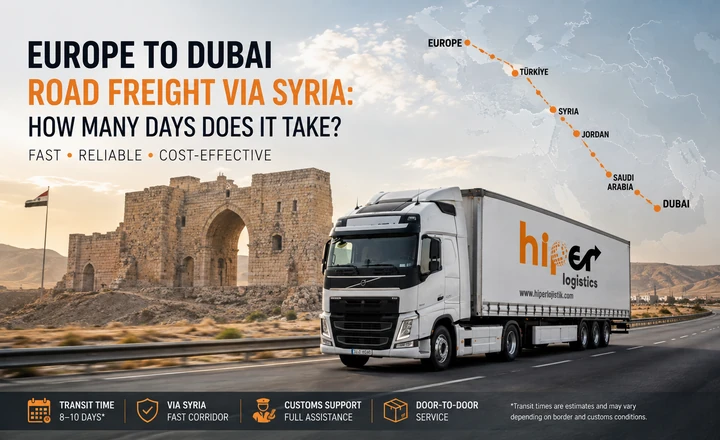
In 2026, the overland connection between Europe and the Gulf has gained additional importance with the renewed operation of the Turkey–Syria–Jordan–Saudi Arabia corridor for applicable international road freight. This creates a practical land route for suitable European cargo moving toward Saudi Arabia, Kuwait, Qatar, the UAE, Dubai and Oman.
Hiper Logistics provides international FTL, TIR, project cargo, heavy transport, oversized cargo and specialized road freight solutions connecting Europe with Turkey, the Middle East and GCC markets.
For customers, the process can be summarized as:
European pickup → export customs → Turkey → Syria → Jordan → Saudi Arabia → GCC → final delivery
The exact route depends on the destination, cargo type, vehicle, customs requirements and current operating conditions.
How Does Road Freight from Europe to the Middle East Work?
A European-to-Middle East road shipment normally consists of several coordinated stages.
The basic logistics process is:
1. Cargo collection in Europe
The truck collects the goods from the factory, warehouse or supplier.
2. Export customs
The shipment completes the required export procedures in its country of origin.
3. European transit
The vehicle travels toward the selected Middle East corridor.
4. Turkey transit
Turkey provides a strategic connection between Europe and the Middle East.
5. Middle East transit
For applicable 2026 shipments, the route can continue through Syria and Jordan toward Saudi Arabia.
6. GCC entry
The truck continues toward the destination country, such as Saudi Arabia, Kuwait, Qatar, the UAE or Oman.
7. Import customs
The cargo completes the destination country’s customs procedures.
8. Final delivery
The shipment is delivered to the customer’s warehouse, factory, project site or agreed address.
This structure allows Hiper Logistics to coordinate the shipment as a single international freight operation.
What Is the 2026 Europe to Middle East Road Freight Route?
For suitable cargo in 2026, one important overland corridor can be structured as:
Europe → Turkey → Syria → Jordan → Saudi Arabia → UAE / GCC
Depending on the final destination, the shipment can then continue toward:
- Dubai
- Abu Dhabi
- Saudi Arabia
- Kuwait
- Qatar
- Oman
- Other GCC destinations
The Turkey–Syria–Jordan–Saudi Arabia corridor is particularly important for current Europe-to-Gulf road freight planning. Regional logistics information published in 2026 lists the Turkey–Syria, Syria–Jordan and Gulf–Saudi Arabia–Jordan–Syria connections as active.
The exact route should be confirmed for every shipment because border conditions, customs procedures and operating restrictions can change.
Why Is Turkey Important for Europe to Middle East Transport?
Turkey is one of the most strategically important transit countries for European road freight heading toward the Middle East.
Its geographical position creates a connection between:
Europe → Anatolia → Levant → Gulf
For European exporters, Turkey can therefore form the main bridge between the European road network and the Middle Eastern road network.
Hiper Logistics can organize European pickup and coordinate the onward transportation according to the selected destination.
Europe to Middle East Transport via Syria in 2026
The renewed Syria corridor is one of the most significant developments for European-to-Gulf road freight.
The applicable route can be structured as:
Turkey → Syria → Jordan → Saudi Arabia → UAE
The Cilvegözü–Bab al-Hawa connection provides an important Turkey–Syria crossing, while Nasib–Jaber connects Syria with Jordan. Current regional logistics information identifies both corridors as active.
For European exporters, this creates an overland connection toward the Gulf without automatically requiring the cargo to be routed through an alternative eastern corridor.
However, the appropriate route must always be confirmed before dispatch.
Which European Countries Can Ship by Road to the Middle East?
Hiper Logistics can coordinate road freight collections from major European markets, including:
Germany to Middle East
Germany is one of Europe’s largest industrial and export markets. Machinery, automotive components, industrial equipment and commercial cargo are common road-freight categories.
France to Middle East
French industrial and commercial exporters can use FTL and specialized road transport solutions toward Middle Eastern destinations.
Italy to Middle East
Italy is an important origin for machinery, automotive products, industrial equipment and manufactured goods.
Spain to Middle East
Spanish exporters can use international road freight for commercial and industrial shipments toward the Gulf.
Netherlands to Middle East
The Netherlands is strategically important for European distribution and international cargo originating from the Benelux region.
Belgium to Middle East
Belgium provides an important European logistics and industrial origin for Middle East-bound cargo.
Poland to Middle East
Poland’s growing manufacturing sector creates demand for long-distance FTL and specialized road freight.
Czech Republic to Middle East
Czech industrial cargo can be collected and transported through the European–Turkey–Middle East corridor.
Romania to Middle East
Romanian exporters can use international FTL and project cargo solutions toward Turkey and the Gulf.
Switzerland to Middle East
Swiss machinery, industrial and commercial cargo can be coordinated through the European road network toward Turkey and the Middle East.
United Kingdom to Middle East
UK cargo can also be transported toward the Middle East by truck, with an initial Channel crossing connecting the UK to continental Europe.
How Long Does Europe to Middle East Road Freight Take?
There is no single transit time that applies to every European-to-Middle East shipment.
The schedule depends on:
- European pickup location
- Destination country
- Loading readiness
- European transit
- Turkey border procedures
- Turkey–Syria crossing
- Syria transit
- Syria–Jordan border
- Jordan transit
- Saudi Arabia transit
- GCC customs
- Cargo type
- Vehicle type
- Final delivery address
For example, a shipment from southern Germany to Dubai will have a different operating schedule from cargo collected in Spain or the UK.
Hiper Logistics therefore provides a shipment-specific transit estimate rather than using one generic number for every country.
What Documents Are Required for Europe to Middle East Road Freight?
International road freight requires accurate commercial and customs documentation.
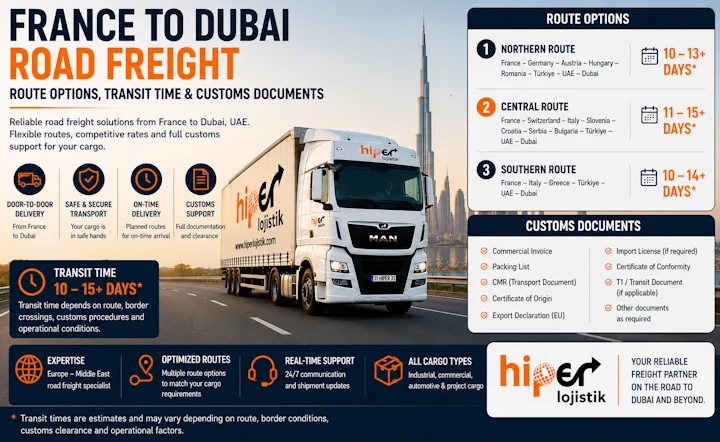
Depending on the origin, destination and cargo, documents can include:
- Commercial invoice
- Packing list
- Certificate of origin
- Export customs declaration
- CMR
- Transit documents
- TIR documentation where applicable
- Import documentation
- Product-specific certificates
- Special permits
The exact requirements depend on:
Product + HS code + origin + destination + importer + applicable regulations.
For this reason, documents should be checked before loading.
What Is TIR Transport to the Middle East?
TIR is an international customs transit system designed to facilitate the movement of goods across borders under customs control.
It can be particularly relevant to long-distance European-to-Middle East road transport involving multiple transit countries.
For applicable shipments, TIR can help structure the customs transit process across the international road journey.
However, TIR does not eliminate customs requirements. Export, transit and import procedures still need to be completed.
The exact TIR structure should be determined according to the shipment and countries included in the route.
Europe to Middle East FTL Transport
FTL (Full Truckload) is one of the most practical solutions for companies shipping larger volumes or cargo requiring dedicated truck capacity.
FTL is suitable for:
- Machinery
- Industrial products
- Automotive components
- Construction materials
- Factory equipment
- Commercial cargo
- Large-volume shipments
- Project cargo
A dedicated truck can reduce unnecessary handling and provide better control over the shipment.
For long-distance Middle East transportation, this can be especially valuable for fragile, high-value or specialized cargo.
Europe to Middle East LTL and Partial Load Transport
Not every shipment requires a complete truck.
LTL / partial-load transport can be considered when consolidation is operationally suitable.
The decision should be based on:
CBM + LDM + weight + cargo characteristics + handling + destination.
For certain cargo, FTL may still be more efficient even when the truck is not completely full because it can reduce handling and simplify the delivery process.
Europe to Middle East Heavy and Oversized Transport
Hiper Logistics can also organize specialized transportation for cargo exceeding standard dimensions.
Typical cargo includes:
- Industrial machinery
- Construction equipment
- Production lines
- Heavy equipment
- Energy equipment
- Infrastructure components
- Large industrial structures
Before transportation, the cargo should be assessed according to:
- Length
- Width
- Height
- Gross weight
- Loading method
- Securing requirements
- Trailer configuration
- Route restrictions
- Permit requirements
- Unloading conditions
Depending on the cargo, flatbed, sal kasa or lowbed trailers may be appropriate.
Europe to Middle East Project Cargo
Project cargo requires detailed planning before dispatch.
A professional project transport process can include:
Cargo survey → Dimensions → Weight → Equipment selection → Route study → Permit planning → Border assessment → Loading → International transit → Final delivery
This is particularly important for machinery and equipment that cannot be transported using standard trailer configurations.
The route should be assessed before the cargo is loaded, particularly when dimensions exceed normal road limits.
How Is Customs Managed from Europe to the Middle East?
Customs management is one of the most important parts of international road freight.
The shipment can involve several customs stages:
European export → Turkey transit → Middle East transit → GCC import
Each stage can require different documentation and customs procedures.
A discrepancy between the invoice, packing list, cargo and customs declaration can create delays.
For this reason, the freight forwarder should review the shipment information before dispatch.
Europe to Dubai Road Freight
Dubai is one of the most important GCC destinations for European road freight.
A suitable 2026 route can be structured as:
Europe → Turkey → Syria → Jordan → Saudi Arabia → UAE → Dubai
Hiper Logistics can provide:
- Europe to Dubai FTL
- TIR transport
- Project cargo
- Heavy transport
- Oversized transport
- Door-to-door delivery
- Customs coordination
The final transit plan depends on the European origin and Dubai delivery address.
Europe to Saudi Arabia Road Freight
Saudi Arabia is a major destination for European industrial and commercial cargo.
Depending on the shipment, the road corridor can be planned through:
Europe → Turkey → Syria → Jordan → Saudi Arabia
Saudi Arabia can also function as a transit country for cargo continuing toward the wider Gulf region.
Europe to Kuwait Road Freight
For Kuwait-bound cargo, the logistics chain can continue from the southern corridor through Saudi Arabia toward Kuwait.
Typical shipments include:
- Machinery
- Industrial products
- Automotive components
- Construction materials
- Commercial goods
The exact customs and border procedures depend on the shipment and importer.
Europe to Qatar Road Freight
Qatar-bound road freight can also be coordinated through the Gulf road network.
For suitable shipments, the route can continue through Saudi Arabia toward Qatar.
Because Qatar is connected to the wider GCC road network through Saudi Arabia, final border and customs planning is an important part of the transport operation.
Europe to Oman Road Freight
Oman-bound cargo requires additional Gulf route planning after entering the GCC region.
Depending on the operational solution, cargo can continue toward Oman after reaching the UAE or through another applicable GCC transit structure.
For Muscat, Sohar and Salalah, the final delivery plan should be determined according to the cargo and destination address.
How Much Does Europe to Middle East Road Freight Cost?
There is no universal Europe-to-Middle East freight price.
The quotation depends on:
- Pickup country
- Pickup city
- Destination
- Cargo dimensions
- Gross weight
- CBM
- LDM
- Cargo type
- FTL or LTL
- Trailer type
- Customs requirements
- Special permits
- Loading conditions
- Delivery requirements
An oversized machinery shipment can have a completely different cost structure from standard FTL cargo.
For this reason, Hiper Logistics calculates freight based on the actual shipment profile.
What Can Delay Europe to Middle East Road Transport?
International road freight can be affected by several variables.
Border Congestion
Heavy traffic can increase processing time.
Customs Documentation
Incorrect documents can cause additional processing.
Cargo Inspection
Customs inspections can affect the planned schedule.
Vehicle Restrictions
Certain routes may impose restrictions on vehicle type, dimensions or operating hours.
Special Permits
Oversized cargo may require permits before entering specific road sections.
Regional Conditions
Border and road conditions can change, particularly on long international routes.
Therefore, a professional logistics provider should communicate a realistic transit window, not an unconditional delivery guarantee.
Why Choose Hiper Logistics for Europe to Middle East Transport?
Hiper Logistics coordinates international freight from Europe through Turkey and toward the Middle East and GCC.
Our solutions include:
- Europe to Middle East road freight
- FTL transport
- TIR transport
- LTL / partial loads
- Project cargo
- Heavy transport
- Oversized cargo
- Lowbed transport
- Flatbed transport
- Door-to-door delivery
- Customs coordination
The route and equipment are selected according to the actual cargo rather than using a one-size-fits-all solution.
What Information Is Needed for a Europe to Middle East Freight Quote?
To receive an accurate quotation, send Hiper Logistics:
Pickup
- Country
- City
- Postal code
- Full pickup address
Delivery
- Country
- City
- Full delivery address
Cargo
- Product description
- Number of packages
- Length
- Width
- Height
- Total weight
- CBM
- LDM
- Stackable / non-stackable
Transport
- Loading date
- Required delivery date
- FTL or LTL
- TIR requirement
- Special handling
- Oversized dimensions
This information allows Hiper Logistics to determine the appropriate route, truck, customs structure and expected transit window.
Europe to Middle East Road Freight: Final Takeaway
Road freight from Europe to the Middle East is a coordinated international transport process involving European export procedures, Turkey transit, Middle Eastern border crossings, GCC customs and final delivery.
For suitable shipments in 2026, the important overland corridor can be summarized as:
Europe → Turkey → Syria → Jordan → Saudi Arabia → GCC
From the GCC network, cargo can continue toward Dubai, Abu Dhabi, Saudi Arabia, Kuwait, Qatar, Oman and other regional destinations.
The key to successful transportation is not simply choosing a truck. It is coordinating:
Route + vehicle + customs + TIR + documents + border crossings + cargo preparation + final delivery.
Hiper Logistics provides FTL, TIR, project cargo, heavy transport and specialized road freight solutions for companies shipping from Europe to the Middle East.
Request a Europe to Middle East Freight Quote
Send Hiper Logistics:
- European pickup address
- Middle East delivery address
- Product description
- Cargo dimensions
- Total weight
- CBM / LDM
- Number of packages
- Loading date
Hiper Logistics can evaluate the appropriate 2026 Europe–Turkey–Syria–Jordan–Gulf route and prepare a shipment-specific road freight solution.
Similar Services


Comments