



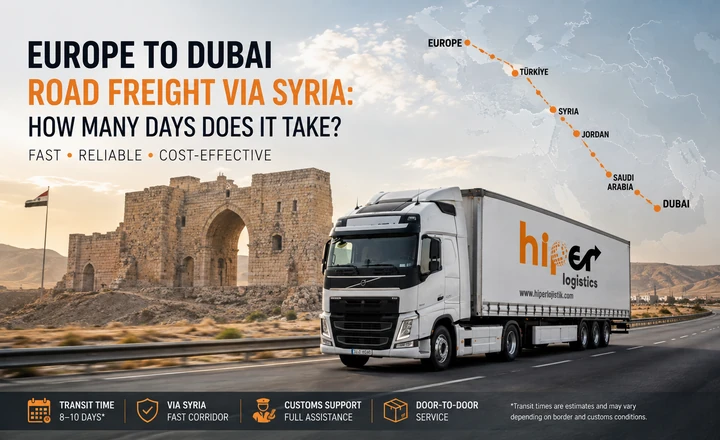
Europe to Dubai Road Freight via Syria: How Many Days Does It Take?
Europe to Dubai road freight via Syria can be planned as a strategic overland corridor connecting Europe, Türkiye, Syria, Jordan, Saudi Arabia and the United Arab Emirates.
The main route is:
Europe → Türkiye → Syria → Jordan → Saudi Arabia → UAE → Dubai
For European shippers, the total transit time depends heavily on the pickup city, border procedures, customs clearance, vehicle regulations and whether cargo transfer or transshipment is required along the Syrian corridor.
As a practical planning range, Europe-to-Dubai road freight via Syria should generally be quoted according to the exact European origin and current border conditions rather than using one fixed number of days.
For example, current commercial road operations show approximately 7–10 days from Germany or Italy to Damascus/Aleppo on Syria-bound routes, while the UAE–Saudi Arabia–Jordan–Syria corridor is currently assessed at around 8–10 days in the opposite direction. These figures demonstrate why the Europe-to-Dubai transit window must be calculated shipment by shipment.
This guide explains the Europe–Türkiye–Syria–Jordan–Saudi Arabia–Dubai road freight route, estimated transit times, border crossings, customs considerations, transshipment requirements and the operational factors that can affect delivery.
Europe to Dubai via Syria: Route at a Glance
| Route Section | Main Corridor | Indicative Planning |
| Germany / Central Europe → Türkiye | European road network → Türkiye | Origin dependent |
| Türkiye → Syria | Türkiye → Cilvegözü / Bab al-Hawa | Around 1–2 days to northwest Syria under suitable conditions |
| Northern Syria → Central Syria | Aleppo → Homs → Damascus | Cargo and route dependent |
| Syria → Jordan | Damascus → Nassib / Jaber | Border and customs dependent |
| Jordan → Saudi Arabia | Jordan → Al-Omari / Al-Haditha | Border dependent |
| Saudi Arabia → UAE | Saudi Arabia → Al Batha / Al Ghuwaifat | Border dependent |
| UAE → Dubai | UAE border → Dubai | Destination dependent |
The Logistics Cluster currently identifies the Türkiye–Syria corridor through Cilvegözü–Bab al-Hawa as active, with an indicative lead time of approximately 1–2 days for the Türkiye-to-northwest-Syria section. It also identifies the Jordan–Syria Nassib–Jaber corridor as active, with approximately two days depending on customs clearance and border congestion.
1. What Is the Europe to Dubai via Syria Road Freight Route?
The Syria corridor provides a land connection between European markets and the Gulf through the Levant.
The core route is:
Germany / Belgium / Netherlands / France / Italy / Poland
↓
Türkiye
↓
Syria
↓
Jordan
↓
Saudi Arabia
↓
United Arab Emirates
↓
Dubai
Unlike a conventional Europe-to-Gulf maritime solution, this route is designed around overland transportation and regional border crossings.
The corridor is particularly relevant when a shipper needs:
- Faster delivery than conventional sea freight
- Door-to-door road transportation
- Dedicated FTL
- Partial-load solutions
- Industrial cargo transportation
- Automotive parts
- Machinery
- Construction materials
- Commercial goods
- Time-sensitive shipments
- Alternative routing around disrupted maritime corridors
Syria’s geographical position makes it strategically significant because it sits between Türkiye, Jordan, the Mediterranean and the Gulf region. Syrian transport authorities have explicitly highlighted the country’s potential role as a land bridge connecting European and Gulf markets.
2. How Many Days Does Europe to Dubai by Road via Syria Take?
There is no single universal transit time for Europe-to-Dubai road freight.
A professional estimate should be calculated using:
European pickup location + Türkiye transit + Syria border + Syrian inland movement + Jordan border + Saudi transit + UAE border + final Dubai delivery
For planning purposes, the complete shipment should normally be quoted as a transit window, not an unconditional fixed delivery date.
A practical estimate can be influenced by:
- European origin
- Truck type
- FTL or LTL
- Cargo dimensions
- Customs status
- Border congestion
- Transshipment requirements
- Driver regulations
- Public holidays
- Security restrictions
- UAE customs clearance
- Final delivery location
This is particularly important for the Syria corridor because transport rules can change faster than on conventional EU road routes.
3. Why Use Syria for Europe to Dubai Road Freight?
The Syrian corridor offers a fundamentally different geographic connection from the Iraq route.
Instead of:
Europe → Türkiye → Iraq → Jordan → Saudi Arabia → UAE
the alternative corridor is:
Europe → Türkiye → Syria → Jordan → Saudi Arabia → UAE
The strategic advantage is geographical.
After entering Syria from Türkiye, cargo can continue south through the Levant toward Jordan and then Saudi Arabia.
This creates a direct north-south logistics concept:
Türkiye → Syria → Jordan → Saudi Arabia → GCC
Türkiye, Syria and Jordan have also discussed strengthening regional road and rail connectivity toward Saudi Arabia, demonstrating the wider strategic importance of the corridor.
4. Türkiye to Syria: Cilvegözü–Bab al-Hawa
For cargo entering Syria from Türkiye, one of the principal commercial crossings is:
Cilvegözü, Türkiye → Bab al-Hawa, Syria
This border crossing connects the Turkish road network with northwestern Syria.
The current Logistics Cluster route assessment lists:
Türkiye → Syria
via:
Cilvegözü–Bab al-Hawa
as an active overland corridor with an indicative lead time of approximately 1–2 days for the Türkiye-to-northwest-Syria segment.
For Europe-origin cargo, the European leg is added before this border crossing.
5. What Happens After the Truck Enters Syria?
Depending on the destination and cargo arrangement, the shipment may continue through the Syrian road network toward:
Aleppo → Homs → Damascus → Southern Syria
before reaching the Jordanian border.
For Dubai-bound freight, the strategic direction is:
Northern Syria
↓
Central Syria
↓
Damascus
↓
Nassib
↓
Jordan
The exact operational route can vary according to:
- Current road conditions
- Border regulations
- Customs requirements
- Truck eligibility
- Cargo type
- Security conditions
- Available transport partners
This is why Syria-bound logistics should be managed by an operator with active regional coordination rather than treated as a conventional European road shipment.
6. Syria to Jordan: Nassib–Jaber Border Crossing
The principal southern connection between Syria and Jordan is:
Nassib, Syria ↔ Jaber, Jordan
The crossing forms the critical bridge between the Syrian road network and the Jordanian logistics network.
The Logistics Cluster currently lists the Jordan–Syria corridor through Nassib–Jaber as active, with an indicative lead time of approximately two days depending on border congestion and customs clearance.
This makes Nassib–Jaber one of the most important border points for a Syria-to-Gulf road freight strategy.
7. Jordan to Saudi Arabia
After entering Jordan, Dubai-bound cargo continues south toward Saudi Arabia.
The general route is:
Syria
↓
Jordan
↓
Al-Omari / Al-Haditha
↓
Saudi Arabia
↓
Al Batha
↓
United Arab Emirates
The Jordan–Saudi border therefore becomes the next major customs and transit stage.
At this point, shipment planning must consider:
- Saudi customs
- Transit declarations
- Vehicle requirements
- Driver documentation
- Cargo-specific permits
- Border queues
- Destination customs arrangements
8. Saudi Arabia to Dubai
After crossing Saudi Arabia, the shipment continues toward the UAE.
A typical corridor is:
Saudi Arabia → Al Batha → Al Ghuwaifat → UAE → Dubai
The UAE–Saudi border is therefore the final major international border before the shipment enters the UAE.
Once the truck completes UAE entry formalities, the final movement to Dubai can continue toward:
- Dubai
- Jebel Ali
- Dubai South
- Free zones
- Industrial areas
- Warehouses
- Final consignee locations
The Logistics Cluster identifies the Al Ghuwaifat/Batha UAE–Saudi crossing as part of the active Gulf–Jordan–Syria overland corridor.
9. Europe to Dubai via Syria: Example Route
A Germany-origin shipment could follow:
Munich, Germany
↓
Austria / Southeast Europe
↓
Türkiye
↓
Cilvegözü
↓
Bab al-Hawa
↓
Aleppo
↓
Homs
↓
Damascus
↓
Nassib
↓
Jaber
↓
Jordan
↓
Al-Omari / Al-Haditha
↓
Saudi Arabia
↓
Al Batha
↓
Al Ghuwaifat
↓
UAE
↓
Dubai
This is the route architecture that should be evaluated when a shipper specifically requests a Syria corridor.
10. Germany to Dubai via Syria
Germany is one of the most important European origins for Middle East road freight.
A Germany-to-Dubai shipment via Syria can be structured as:
Germany → Türkiye → Syria → Jordan → Saudi Arabia → UAE → Dubai
The European leg is highly dependent on the pickup city.
For example:
Munich → Dubai
and
Hamburg → Dubai
should not receive the same transit estimate.
Current commercial Syria-bound road operations indicate approximately 7–10 days from Munich to Aleppo/Damascus, demonstrating that Germany-to-Syria road freight can operate within a defined regional transit window.
The Dubai leg must then be added according to the current southern corridor conditions.
11. Italy to Dubai via Syria
Northern Italy has strong road connectivity toward Türkiye.
A possible route is:
Milan → Türkiye → Syria → Jordan → Saudi Arabia → UAE → Dubai
Commercial road operations currently advertise approximately 7–10 days from Milan to Aleppo/Damascus on Syria-bound services.
For Dubai-bound cargo, this should be treated as the European-to-Syria portion rather than the complete Europe-to-Dubai transit.
The final delivery estimate must include:
- Syria–Jordan transit
- Jordan–Saudi border
- Saudi–UAE border
- UAE customs
- Dubai delivery
12. France to Dubai via Syria
France-to-Dubai road freight requires a longer European first leg.
The route can be structured as:
France → Italy / Southeast Europe → Türkiye → Syria → Jordan → Saudi Arabia → UAE → Dubai
The exact route depends on:
- French pickup city
- Cargo readiness
- Truck availability
- European traffic
- Border selection
- Customs requirements
Paris, Lyon, Marseille and other French origins should therefore receive different transit calculations.
13. Belgium and Netherlands to Dubai via Syria
For Belgium and Netherlands origins, the route begins farther west:
Belgium / Netherlands
↓
Germany / Central Europe
↓
Southeast Europe
↓
Türkiye
↓
Syria
↓
Jordan
↓
Saudi Arabia
↓
UAE
↓
Dubai
The longer European first leg means the total transit window will generally be longer than an equivalent shipment originating in southern Germany or northern Italy.
This is precisely why origin-city-based transit calculations are more useful than generic “Europe to Dubai” promises.
14. Is Europe to Dubai via Syria Faster Than Sea Freight?
For suitable cargo, road freight can offer a significant time advantage over conventional sea-based logistics.
However, the comparison should not simply be:
Road = faster
Sea = slower
The correct comparison is:
Total door-to-door transit time
including:
- Origin pickup
- Export customs
- Port handling
- Ocean transit
- Transshipment
- Destination port handling
- Import customs
- Final delivery
Road freight can reduce the number of separate logistics stages for time-sensitive cargo.
This is especially relevant when the shipper needs the goods delivered directly to a Dubai warehouse rather than to a port.
15. Why the Syria Corridor Is Relevant in 2026
The strategic importance of the Syria corridor has increased because regional logistics operators are looking for alternatives to disrupted maritime routes.
Current logistics reporting identifies:
Dubai → Saudi Arabia → Jordan → Syria → Türkiye
as an active overland corridor.
The reverse direction provides the geographic framework for:
Türkiye → Syria → Jordan → Saudi Arabia → Dubai.
In July 2026, regional transport discussions also highlighted efforts to develop north-south transport connections linking Türkiye, Syria, Jordan and Saudi Arabia.
This gives the corridor significance beyond a single trucking service.
It is part of a broader attempt to reconnect European, Levantine and Gulf logistics networks by land.
16. Important: Syria Truck and Transshipment Rules
This is one of the most important sections of the entire article.
The Syria corridor should not be marketed as a simple European truck driving uninterrupted to Dubai without qualification.
Transport regulations can require:
- Vehicle changes
- Cargo transfer
- Local transport partners
- Border-side transshipment
- Additional customs procedures
In February 2026, Syria’s restrictions on foreign cargo vehicles created significant delays and required border transfers on some international routes. Contemporary reporting described delays of up to two weeks on affected movements.
Jordanian authorities also confirmed that Jordanian trucks continued operating under a back-to-back system during the period when foreign trucks faced restrictions.
For this reason, Hiper Logistics should always verify the applicable rules before dispatch.
The correct professional wording is:
Syria corridor operations are subject to current Syrian, Jordanian, Saudi and UAE transport and customs regulations, including possible transshipment or back-to-back requirements.
This is far more credible than promising an unconditional fixed transit time.
17. What Is a Back-to-Back Trucking Operation?
A back-to-back operation means that cargo may need to be transferred from one vehicle to another at a border or designated logistics point instead of the original foreign truck continuing through the next country.
This can happen because of:
- Foreign truck restrictions
- Cabotage regulations
- Bilateral transport agreements
- Customs requirements
- Local transport rules
For Syria-related logistics, the possibility of transshipment should be considered during route planning.
The impact can include:
Additional handling + additional documentation + additional time + additional cost
Therefore, the freight quotation should reflect the actual operating model.
18. Customs Documentation for Europe to Dubai via Syria
A multi-country road shipment requires disciplined documentation.
Depending on cargo and customs procedure, the shipment may require:
Commercial Documents
- Commercial Invoice
- Packing List
- Certificate of Origin
- Sales documentation where applicable
Transport Documents
- CMR
- Transit documentation
- Vehicle documents
- Driver documents
- Applicable permits
Customs Documents
- Export declaration
- Transit declaration
- Import declaration
- Customs guarantees where applicable
Cargo-Specific Documents
Depending on the commodity:
- Product certificates
- Conformity documents
- Health certificates
- Phytosanitary documents
- Dangerous Goods documentation
- MSDS/SDS
- Import permits
The exact document set should be established before loading.
19. Why Customs Accuracy Matters More on the Syria Corridor
A Europe-to-Dubai shipment can cross several customs jurisdictions.
That means one documentation error can affect multiple stages.
Examples include:
- Incorrect HS code
- Invoice mismatch
- Wrong consignee
- Incorrect weight
- Incorrect quantity
- Missing certificate
- Incorrect customs value
- Missing transit document
A professional logistics provider should therefore conduct a pre-dispatch document check.
The objective is simple:
Resolve documentation problems before the truck reaches the border.
20. TIR on the Syria Route
TIR should not be confused with the CMR.
CMR
The CMR is the international road consignment note documenting the road transport contract and shipment details.
TIR
TIR is a customs transit system designed to facilitate international movement of goods under customs control.
Whether TIR is applicable to a particular Europe-to-Dubai via Syria shipment depends on the route, customs regime, participating countries and current operating requirements.
Therefore, the logistics provider should determine the appropriate customs transit mechanism before dispatch.
21. FTL vs. LTL for Europe to Dubai via Syria
Full Truckload — FTL
FTL is generally preferable when:
- Delivery time is critical
- Cargo is high value
- Cargo requires dedicated handling
- Direct transport is preferred
- The shipment occupies substantial trailer capacity
FTL minimizes unnecessary consolidation.
Less Than Truckload — LTL
LTL can be appropriate when:
- Cargo volume is smaller
- Freight cost is more important than absolute speed
- Consolidation is commercially viable
However, LTL can introduce:
- Additional handling
- Consolidation time
- Transshipment
- Hub operations
- More complex customs planning
For urgent Europe-to-Dubai cargo, FTL often provides better operational control.
22. What Cargo Can Be Transported via Syria to Dubai?
The corridor can be evaluated for many commercial cargo categories, including:
- Machinery
- Industrial equipment
- Automotive components
- Spare parts
- Construction materials
- Furniture
- FMCG
- Retail products
- Exhibition cargo
- Commercial goods
- Temperature-controlled products
- Project cargo
Special cargo requires additional assessment.
23. Oversized Cargo from Europe to Dubai via Syria
Oversized cargo should never be quoted using standard truck assumptions.
The logistics provider must evaluate:
Length + Width + Height + Gross Weight
along with:
- Axle loads
- Trailer configuration
- Bridge restrictions
- Road geometry
- Border infrastructure
- Special permits
- Escort requirements
- Loading and unloading facilities
Possible equipment may include:
- Lowbed
- Flatbed
- Extendable trailer
- Mega trailer
- Special project equipment
For project cargo, route engineering must begin before the freight rate is finalized.
24. Temperature-Controlled Cargo
Refrigerated cargo requires additional planning.
The logistics provider must consider:
- Reefer equipment
- Temperature range
- Continuous monitoring
- Border waiting time
- Customs inspection
- Driver procedures
- Backup arrangements
For pharmaceutical, food or other temperature-sensitive cargo, the Syria corridor should only be selected after confirming the complete cold-chain operating model.
25. What Can Delay Europe to Dubai via Syria?
The main risks include:
1. Türkiye–Syria border congestion
Cilvegözü–Bab al-Hawa can experience variable traffic.
2. Syrian transport regulations
Foreign truck entry and cargo transfer requirements can change.
3. Syrian customs
Transit procedures may require additional coordination.
4. Nassib–Jaber border
Customs clearance and congestion can affect the schedule.
5. Jordan–Saudi border
Border processing can add unpredictable time.
6. Saudi–UAE border
Al Batha–Al Ghuwaifat is another important control point.
7. Public holidays
Different national calendars can affect customs offices.
8. Documentation errors
A single incorrect document can delay the shipment.
9. Special cargo permits
Oversized and dangerous goods require additional planning.
26. How Hiper Logistics Can Reduce Transit Risk
A professional Europe-to-Dubai Syria corridor should be managed through route control, not simply truck procurement.
Hiper Logistics can structure the shipment around:
Pre-dispatch document verification
↓
European pickup
↓
Türkiye transit
↓
Cilvegözü–Bab al-Hawa coordination
↓
Syria inland transit
↓
Nassib–Jaber border planning
↓
Jordan transit
↓
Saudi Arabia
↓
Al Batha–Al Ghuwaifat
↓
UAE customs
↓
Dubai final delivery
The critical principle is to monitor each border independently rather than treating the entire journey as one uncontrolled road segment.
27. Why Route Monitoring Matters
International road freight does not stop being a logistics operation once the truck leaves the loading address.
The shipment must be monitored through:
- Border arrival
- Customs processing
- Border exit
- Vehicle changes
- Transit documentation
- Regional transport handover
- Destination customs
- Final delivery
For a Syria corridor, this operational visibility becomes even more important because regulations and border conditions can change.
28. Europe to Dubai via Syria: A Professional Transit-Time Model
A useful way to calculate the expected delivery time is:
T₁ = European pickup → Türkiye
T₂ = Türkiye → Syria
T₃ = Syria → Jordan
T₄ = Jordan → Saudi Arabia
T₅ = Saudi Arabia → UAE
T₆ = UAE → Dubai
Therefore:
Total Transit Time = T₁ + T₂ + T₃ + T₄ + T₅ + T₆ + Operational Buffer
The operational buffer is essential.
It accounts for:
- Border queues
- Customs inspections
- Vehicle transfer
- Documentation corrections
- Holidays
- Security controls
- Unexpected route restrictions
This methodology produces a much more realistic quotation than simply calculating the road distance.
29. Europe to Dubai via Syria vs. Iraq
Both corridors can connect Europe with the Gulf, but they are different logistics products.
| Factor | Syria Corridor | Iraq Corridor |
| Main route | Europe → Türkiye → Syria → Jordan → Saudi → UAE | Europe → Türkiye → Iraq → Jordan → Saudi → UAE |
| Key northern border | Cilvegözü–Bab al-Hawa | Türkiye–Iraq crossing |
| Key Levant border | Nassib–Jaber | Jordan–Saudi connection after Iraq/Jordan |
| Geographic advantage | Türkiye–Levant–Gulf | Türkiye–Mesopotamia–Gulf |
| Operational sensitivity | High | High |
| Transshipment potential | Important | Route-dependent |
| Customs complexity | High | High |
| Best use | Alternative southern/Levant corridor | Alternative Iraq corridor |
The best route should be determined by current border conditions, cargo type, customs feasibility, price and required delivery time.
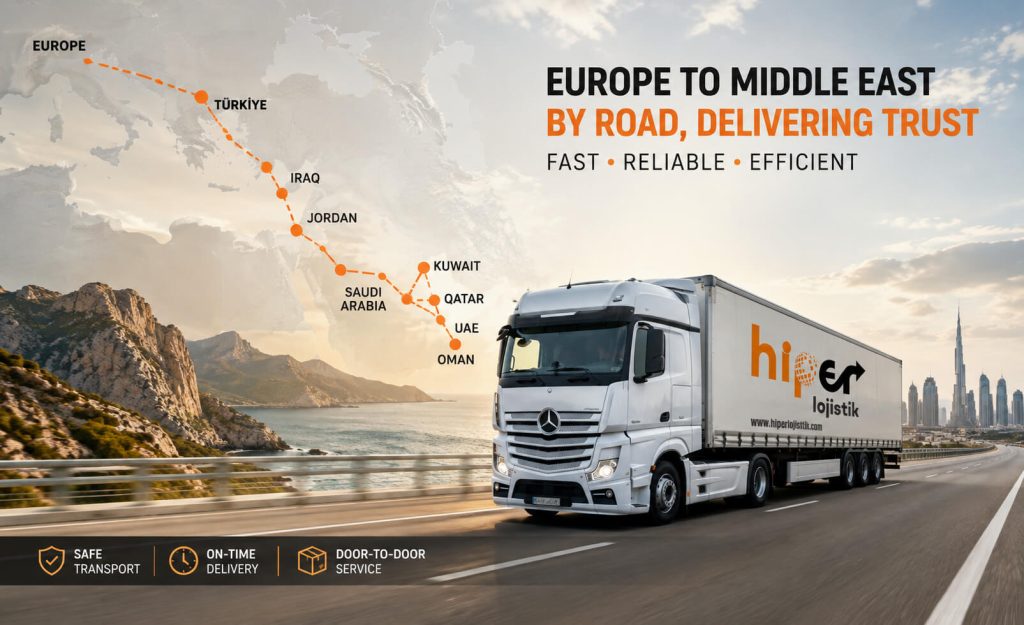
Europe to the Middle East by Road Freight: Routes, Transit Times & Customs Guide
30. Is Syria a Viable Alternative Route to Dubai?
Yes, as an operational corridor subject to current conditions and shipment-specific acceptance.
The Logistics Cluster currently lists the Türkiye–Syria and Syria–Jordan corridors as active, while commercial operators are also advertising Europe/Syria and Gulf/Syria road movements.
At the same time, the corridor remains more operationally sensitive than a standard EU road route.
Therefore, the correct logistics strategy is:
Use Syria when the current border, customs and transport conditions make it the best available corridor.
Do not treat the route as permanently fixed.
31. Europe to Dubai via Syria: Frequently Asked Questions
How many days does Europe to Dubai take via Syria?
The transit time depends on the European origin and current border conditions. A shipment should be quoted using an origin-specific transit window rather than one fixed number.
What is the Europe-to-Dubai Syria route?
The main corridor is:
Europe → Türkiye → Syria → Jordan → Saudi Arabia → UAE → Dubai.
Which border crossing connects Türkiye and Syria?
A principal commercial crossing is:
Cilvegözü–Bab al-Hawa.
The Logistics Cluster currently lists this corridor as active.
Which border crossing connects Syria and Jordan?
The principal southern connection is:
Nassib–Jaber.
It is currently listed as an active road corridor.
Can European trucks drive directly through Syria?
Not necessarily. Current Syrian transport regulations can require cargo transfer or different vehicle arrangements. Foreign truck restrictions have affected regional road freight operations in 2026.
Is transshipment possible?
Yes. Depending on current regulations, cargo may need to be transferred between vehicles at a border or designated logistics point.
Is road freight from Europe to Dubai via Syria faster than sea freight?
For suitable time-sensitive cargo, it can provide a substantially shorter door-to-door logistics chain than conventional maritime transportation. The actual advantage depends on the route and current conditions.
Can FTL cargo move via Syria?
Yes, subject to vehicle eligibility, route conditions and applicable transport regulations.
Can LTL cargo move via Syria?
Potentially, subject to consolidation, customs and current corridor acceptance.
Can machinery be transported via Syria to Dubai?
Yes, but the cargo dimensions, weight, loading method and permits must be reviewed before dispatch.
Can oversized cargo use this route?
Potentially. Oversized shipments require route surveys, equipment selection and applicable permits.
Is Syria route available throughout the year?
The corridor may be operational, but border and transport conditions can change. Availability should be confirmed immediately before booking.
32. Europe to Dubai Road Freight via Syria: The Strategic Opportunity
The re-emergence of Syria as a regional land corridor is strategically significant.
The country’s geography creates a natural connection between:
Türkiye
Syria
Jordan
Saudi Arabia
Gulf
For European exporters, this means that Dubai does not have to be viewed only as a maritime destination.
It can also be approached through a Türkiye–Levant–Gulf land corridor.
Current regional transport initiatives are focused on restoring and expanding north-south road and rail connections between Türkiye, Syria, Jordan and Saudi Arabia.
This makes the Syria corridor an important route to monitor for future Europe–GCC logistics.
33. Why Choose Hiper Logistics for Europe to Dubai via Syria?
Europe-to-Dubai via Syria is not a simple point-to-point trucking service.
It is a multi-country logistics operation requiring:
- Route planning
- Border coordination
- Customs preparation
- Vehicle planning
- Transshipment management
- Driver coordination
- Saudi transit planning
- UAE customs coordination
- Final Dubai delivery
Hiper Logistics approaches the corridor as an integrated international road freight operation.
The objective is to coordinate:
Europe
→ Türkiye
→ Syria
→ Jordan
→ Saudi Arabia
→ UAE
→ Dubai
with the transport model adapted to the cargo and current border regulations.
34. Final Answer: How Many Days Does Europe to Dubai via Syria Take?
The most accurate answer is:
Europe-to-Dubai road freight via Syria does not have one fixed transit time. The delivery window depends on the European pickup city, Türkiye–Syria border conditions, Syrian transport rules, Nassib–Jaber crossing, Jordan–Saudi transit, Saudi–UAE border processing and final Dubai customs clearance.
The strategic route is:
Europe → Türkiye → Cilvegözü/Bab al-Hawa → Syria → Damascus → Nassib/Jaber → Jordan → Saudi Arabia → Al Batha → Al Ghuwaifat → UAE → Dubai
Current logistics assessments confirm that the Türkiye–Syria and Syria–Jordan corridors are active, while regional transport developments continue to strengthen the Türkiye–Syria–Jordan–Saudi connectivity concept.
The key consideration is therefore not simply:
“How many days from Europe to Dubai?”
It is:
“Which Syrian corridor, border arrangement and transport model will provide the most reliable door-to-door delivery for this specific shipment?”
That is where professional route engineering becomes critical.
Hiper Logistics — Europe to Dubai via Syria
Europe → Türkiye → Syria → Jordan → Saudi Arabia → UAE → Dubai
International Road Freight | FTL | LTL | Express | Project Cargo | Customs Coordination
For a shipment-specific transit calculation, Hiper Logistics should evaluate:
Pickup City + Delivery Location + Cargo Dimensions + Weight + Commodity + Ready Date + Customs Status
before confirming the route and transit window.
Similar Services




Comments