



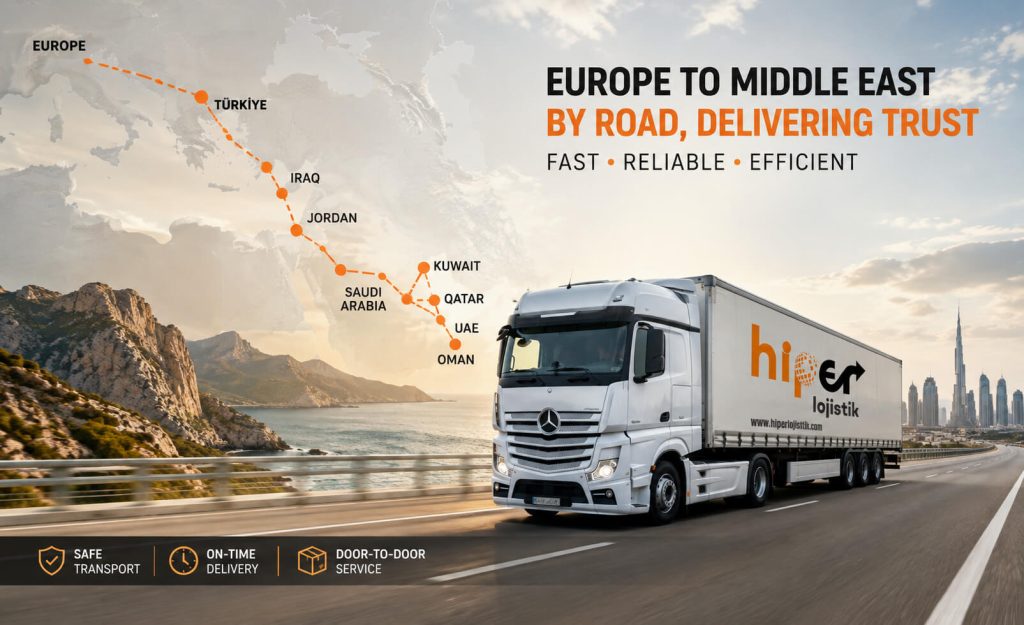
Europe to the Middle East by Road Freight: Routes, Transit Times & Customs Guide
Europe to Middle East road freight has become an increasingly strategic alternative for companies looking for reliable, flexible and time-sensitive transportation between European markets and the Gulf region.
For shipments moving from Germany, Belgium, the Netherlands, France, Italy, Spain, Poland and other European countries to Türkiye, Syria, Jordan, Saudi Arabia, Qatar, Kuwait, the United Arab Emirates and Oman, road freight can provide a direct door-to-door logistics solution without relying entirely on maritime schedules.
For international shippers, however, the key question is not simply whether a truck can reach the Middle East. The real question is:
Which route should be used, how long will the shipment take, which customs procedures apply, and which documents are required?
This guide explains the main Europe–Middle East road freight routes, estimated transit times, customs procedures, border crossings, TIR requirements and operational considerations from a logistics perspective.
For international road freight solutions between Europe, Türkiye and the Middle East, Hiper Logistics provides full truckload, partial-load and project-oriented transportation solutions across major European and Gulf corridors.
Europe to Middle East Road Freight at a Glance
| Route | Typical Road Corridor | Indicative Transit Time* |
|---|---|---|
| Germany → Türkiye | Germany → Austria/Hungary → Balkans → Türkiye | 5–8 days |
| France → Türkiye | France → Italy/Balkans → Türkiye | 6–9 days |
| Poland → UAE | Poland → EU → Türkiye → Syria → Jordan → Saudi Arabia → UAE | Around 10 days |
| Europe → Iraq | Europe → Türkiye → Iraq | 8–14 days |
| Türkiye → Qatar | Türkiye → Syria → Jordan → Saudi Arabia → Qatar | 6–8 days |
| Türkiye → UAE | Türkiye → Syria → Jordan → Saudi Arabia → UAE | 6–8 days |
| Türkiye → Oman | Türkiye → Syria → Jordan → Saudi Arabia → UAE/Oman corridor | 6–10+ days |
| Türkiye → Kuwait | Türkiye → Syria → JO → SA → Kuwait | Route-dependent |
*Transit times are operational estimates rather than guaranteed delivery times. Border congestion, customs inspections, weekends, permits, security procedures, weather and local regulations can materially affect actual transit time.
A real-world example demonstrates the potential of the corridor: IRU reported a Poland-to-UAE road shipment completed in 10 days via Bulgaria, Türkiye, Syria, Jordan and Saudi Arabia, compared with a traditional multimodal journey of around 24 days.
1. What Is Europe to Middle East Road Freight?
Europe to Middle East road freight is the transportation of commercial cargo from European origins to Middle Eastern destinations using trucks and international road corridors.
Depending on the origin and destination, a shipment may pass through several countries before reaching the final consignee.
A typical corridor can look like:
Germany / Belgium / Netherlands / France / Italy / Poland
↓
Balkans
↓
Türkiye
↓
Syria
↓
Jordan
↓
Saudi Arabia
↓
Qatar / UAE / Kuwait / Oman
This corridor is particularly relevant for:
- Full Truckload (FTL)
- Less-than-Truckload (LTL)
- Groupage / consolidated cargo
- Industrial machinery
- Automotive components
- Construction materials
- FMCG
- Spare parts
- Temperature-sensitive cargo
- Exhibition and event cargo
- Project cargo
- Oversized and heavy transport
The most appropriate route depends on the cargo type, origin, destination, customs status, required delivery time and border conditions.
2. The Main Europe–Middle East Road Freight Corridor
One of the most strategically important land corridors is:
Europe → Türkiye → Iraq → Jordan → Saudi Arabia → GCC
Türkiye acts as a critical geographic bridge between Europe and the Middle East.
For cargo originating in Central and Western Europe, the truck first enters Türkiye through the European road network and then continues toward the Middle East.
From Türkiye, the routing can be adapted according to the final destination.
Qatar
Europe → Türkiye → Syria → Jordan → Saudi Arabia → Qatar
UAE / Dubai
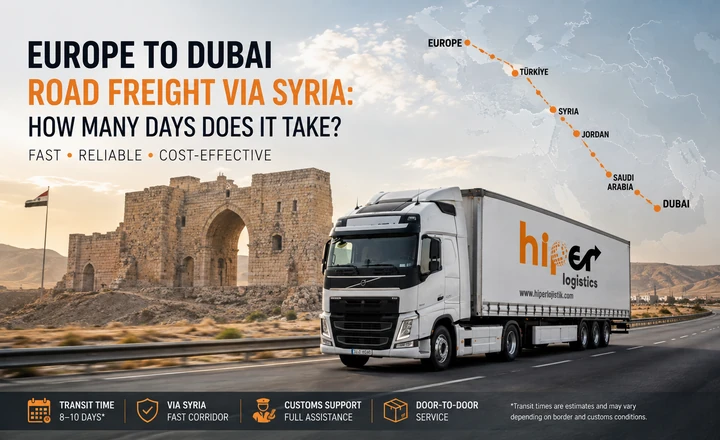
Europe → Türkiye → Syria → Jordan → Saudi Arabia → UAE
Oman
Europe → Türkiye → Syria → Jordan → Saudi Arabia → UAE/Oman
Kuwait
Europe → Türkiye → Syria → Jordan → Saudi Arabia → Kuwait
The Syria corridor has become particularly important because Syria’s integration into the TIR system has strengthened the possibility of more structured international road transit through the country. UNECE identifies the activation of the TIR system in Syria as a major development for regional connectivity.
3. Why Türkiye Is Important for Europe–Middle East Logistics
Türkiye is strategically positioned between European and Middle Eastern logistics networks.
For road freight, this provides an important geographical advantage:
Europe → Türkiye → Middle East
Instead of treating Europe and the Gulf as disconnected logistics markets, Türkiye can function as the central land bridge connecting the two regions.
For freight forwarders and exporters, this creates several operational advantages:
- Direct road connectivity
- Door-to-door delivery
- Flexible routing
- Reduced dependency on vessel schedules
- Ability to transport full truckloads
- Ability to consolidate smaller shipments
- Customs-controlled transit options
- Access to Syria and GCC corridors
- Possibility of dedicated and express transport
This is particularly important for cargo where delivery time is more important than achieving the lowest possible freight rate.
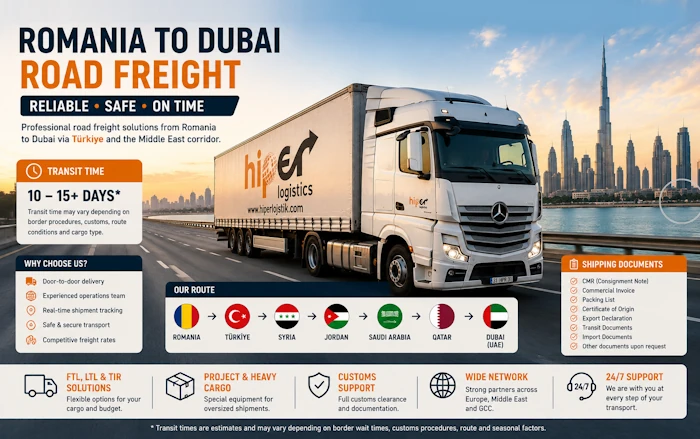
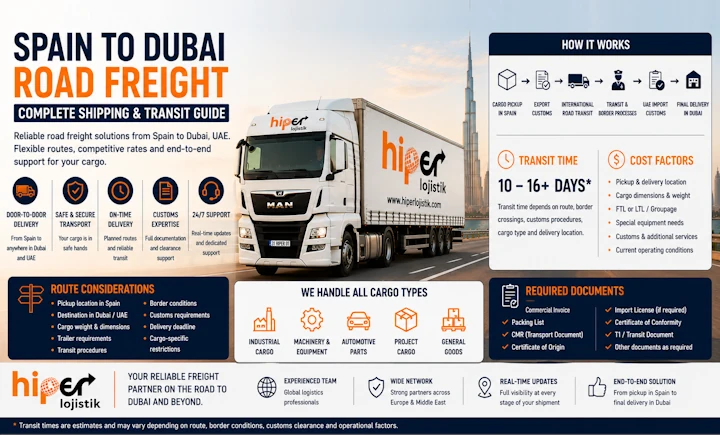
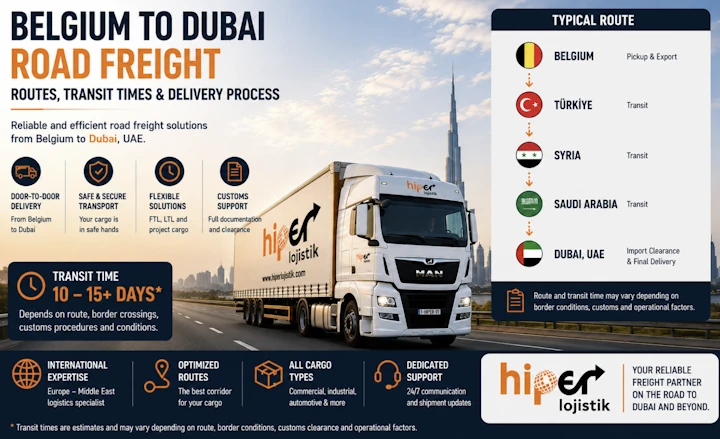
4. Europe to Dubai by Road Freight
Dubai is one of the most important logistics and commercial destinations in the Gulf.
A road freight shipment from Europe to Dubai can follow a corridor such as:
Germany / France / Belgium / Netherlands / Poland
→ Türkiye
→ Syria
→ Jordan
→ Saudi Arabia
→ United Arab Emirates
→ Dubai
The final delivery can be arranged directly to:
- Dubai
- Jebel Ali
- Abu Dhabi
- Sharjah
- Other UAE emirates
The exact customs and delivery configuration depends on whether the shipment is intended for direct import, transit, free-zone delivery or another customs procedure.
For time-sensitive cargo, the advantage of road freight is the possibility of maintaining a single operational chain from European pickup to Middle Eastern delivery.
5. Europe to Qatar by Road Freight
Qatar can be reached from Europe through the southern land corridor:
Europe → Türkiye → Syria → Jordan → Saudi Arabia → Qatar
This route is particularly relevant for:
- Industrial cargo
- Construction materials
- Machinery
- Automotive parts
- Exhibition cargo
- Commercial shipments
- Project logistics
A Türkiye-to-Qatar road shipment may be operationally possible within approximately 6–8 days under favorable conditions, while a Europe-to-Qatar shipment requires additional transit time from the European origin.
Transit time should therefore always be calculated from the actual pickup city, rather than using Türkiye as the starting point.
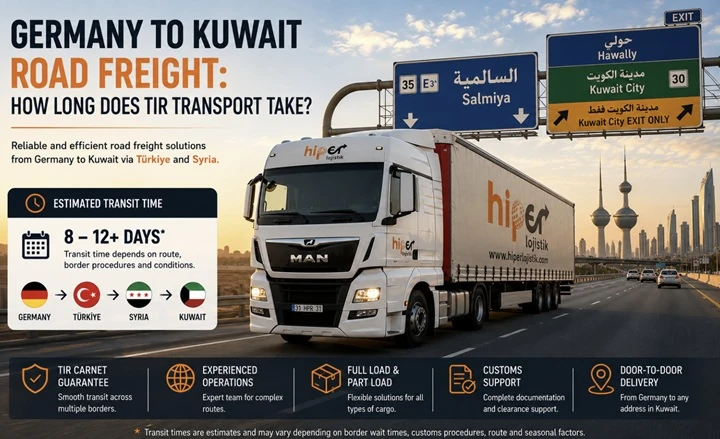
6. Europe to Kuwait by Road Freight
Kuwait can be accessed through the Iraq corridor.
A simplified route is:
Europe → Türkiye → Syria → Jordan → Suadi Arabia → Kuwait
The Syria–Kuwait connection makes this route strategically important for shipments destined for:
- Kuwait City
- Shuwaikh
- Shuaiba
- Industrial areas
- Commercial distribution centers
The operational planning of this corridor requires careful coordination of:
- Customs documents
- Transit declarations
- Border procedures
- Vehicle documentation
- Driver documentation
- Import requirements
- Destination customs clearance
7. Europe to Saudi Arabia by Road Freight
Saudi Arabia is one of the largest Middle Eastern markets for European cargo.
Road freight can connect Europe to Saudi Arabia through:
Europe → Türkiye → Syria → Jordan → Saudi Arabia
Depending on the final destination, the shipment may continue toward:
- Riyadh
- Dammam
- Jeddah
- Mecca region
- Medina region
- Industrial cities
- Other Saudi destinations
Saudi Arabia’s geographic position also makes it a key transit country for shipments moving toward Qatar and parts of the GCC.
8. Europe to Oman by Road Freight
Oman is another destination that can be incorporated into the southern Middle East road network.
A potential corridor is:
Europe → Türkiye → Syria → Jordan → Saudi Arabia → UAE/Oman
For Oman-bound cargo, the final routing should be selected according to:
- Final delivery location
- Border conditions
- Cargo type
- Customs requirements
- Vehicle configuration
- Required delivery time
Muscat, Sohar, Salalah and other Omani destinations can require different operational planning.
9. How Long Does Europe to Middle East Road Freight Take?
There is no single transit time for “Europe to the Middle East.”
The correct calculation depends on at least five variables:
- Pickup location
- Final destination
- Cargo type
- Customs procedure
- Border and road conditions
For example, a shipment from Germany to Iraq cannot be compared directly with a shipment from Poland to Dubai.
A practical planning model is:
Total Transit Time = Driving Time + Border Time + Customs Time + Operational Buffer
The operational buffer is critical.
A route that looks like a six-day journey under ideal road conditions may require additional time because of:
- Customs inspections
- Border queues
- Documentation discrepancies
- Security controls
- Driver rest requirements
- Public holidays
- Weekend restrictions
- Vehicle permits
- Local road restrictions
Therefore, professional freight forwarders should provide an estimated transit window, rather than promising an unrealistic fixed delivery date.
10. Customs Procedures for Europe–Middle East Road Freight
Customs is one of the most important parts of Europe–Middle East road transportation.
The shipment may involve multiple customs jurisdictions:
EU → Türkiye → Syria → Jordan → Saudi Arabia → GCC
Each country may have its own import, transit and documentary requirements.
The exact procedure depends on the customs status of the cargo and the selected route.
11. TIR Carnet and International Customs Transit
The TIR system is one of the most important customs transit mechanisms for international road freight.
UNECE describes TIR as a universal customs transit system covering Europe and extending into North Africa, the Near East and Middle East.
Under the TIR system, goods can move between customs offices under customs control while duties and taxes are generally suspended during transit, subject to the applicable rules.
The system is built around several key principles:
- Secure vehicles or containers
- International guarantee chain
- TIR Carnet
- Mutual recognition of customs controls
- Controlled access for authorized operators
The European Commission also confirms that TIR allows goods to cross international borders under customs control without normally paying import duties and taxes during transit.
This makes TIR highly relevant to long-distance Europe–Middle East road freight.
12. Common Transit and NCTS
For European shipments moving between the EU and Türkiye, Common Transit is another important customs framework.
Türkiye has participated in the Common Transit Convention since 1 December 2012.
The New Computerised Transit System (NCTS) is used for electronic customs transit operations within the applicable Common Transit framework.
For a Europe-to-Middle East shipment, the customs strategy may therefore involve different procedures at different stages of the journey.
A logistics provider must determine:
- Where the export declaration is lodged
- Where transit begins
- Which customs office is used
- Whether TIR is appropriate
- Whether NCTS/Common Transit applies
- Where import customs clearance takes place
- How the transit operation will be discharged
This is why customs planning should be completed before the truck departs, rather than at the border.
13. Documents Required for Europe–Middle East Road Freight
The exact documentation varies according to the country, cargo and customs regime, but a typical international road freight file may include:
Commercial Documents
- Commercial Invoice
- Packing List
- Sales Contract where applicable
- Certificate of Origin
- Export declaration
- Import documentation where applicable
Transport Documents
- CMR
- TIR Carnet where applicable
- Transit declaration
- Vehicle registration documents
- Driver documentation
- Transport authorization documents
Cargo-Specific Documents
Depending on the cargo:
- EUR.1 or other preferential-origin documentation where applicable
- Product certificates
- Health certificates
- Phytosanitary certificates
- Dangerous Goods documentation
- MSDS/SDS
- Technical certificates
- Conformity documents
- Temporary admission documents
The correct document set must always be determined from the actual commodity, HS code, origin, destination and customs procedure.
14. What Can Cause Delays at Middle Eastern Borders?
A common misconception is that the driving distance determines the delivery date.
In international road freight, border and customs performance can be just as important as driving distance.
Common causes of delay include:
1. Incorrect customs data
Incorrect invoice values, HS codes, quantities or consignee information can trigger additional customs procedures.
2. Missing documents
A missing certificate can stop a shipment even when the truck and driver are ready to cross.
3. Customs inspection
Customs authorities can conduct physical or documentary inspections.
4. Border congestion
High traffic volumes can significantly increase waiting times.
5. Public holidays
National holidays in transit or destination countries can affect customs offices and border operations.
6. Vehicle restrictions
Certain cargoes may require special permits or specific vehicle configurations.
7. Special cargo
Oversized, dangerous, temperature-controlled or high-value cargo may require additional controls.
15. FTL vs. LTL for Europe–Middle East Shipments
Choosing between FTL and LTL can materially affect both transit time and cost.
Full Truckload (FTL)
FTL is generally suitable when:
- The cargo fills a substantial portion of the trailer
- The shipment is time-sensitive
- Direct delivery is required
- The cargo requires dedicated handling
- Multiple transshipments should be avoided
The major advantage is operational control.
The truck can generally move from pickup toward the final destination without waiting for other cargo to complete a consolidation plan.
LTL / Groupage
LTL can be more economical for smaller shipments.
However, it may involve:
- Consolidation
- Additional handling
- Hub operations
- Longer planning windows
- More complex customs coordination
For urgent Middle East shipments, dedicated road freight can therefore be preferable even when the cargo does not completely fill a trailer.
16. Road Freight vs. Sea Freight to the Middle East
The right mode depends on the shipment’s priorities.
| Factor | Road Freight | Sea Freight |
|---|---|---|
| Door-to-door capability | Excellent | Usually requires inland transport |
| Transit flexibility | High | Schedule dependent |
| Small urgent shipments | Suitable | Less flexible |
| Full truckload | Excellent | Requires container planning |
| Route flexibility | High | Port dependent |
| Border exposure | Higher | Lower inland border exposure |
| Sailing schedule dependency | Low | High |
| Urgent cargo | Often preferable | Usually slower |
| Large-volume cargo | Suitable | Often more economical |
Road freight should not automatically be considered “cheaper” or “faster.”
The correct comparison is based on total landed logistics cost + transit time + operational risk.
17. How Hiper Logistics Manages Europe–Middle East Road Freight
For an international road freight operation, the most important capability is not simply finding a truck.
The logistics provider must coordinate the entire transport chain.
For Europe–Middle East shipments, this includes:
Pickup planning
→ Export customs
→ European transit
→ Türkiye entry
→ Transit/customs coordination
→ Middle East border crossings
→ Destination customs
→ Final delivery
Hiper Logistics focuses on coordinating this process as a single logistics operation.
The company operates international road freight solutions connecting European markets with Türkiye and Middle Eastern destinations, including GCC markets.
18. Which European Countries Can Ship by Road to the Middle East?
Europe-to-Middle East road freight can be organized from major European markets including:
Western Europe
- Germany
- France
- Belgium
- Netherlands
- Luxembourg
Southern Europe
- Italy
- Spain
- Portugal
Central and Eastern Europe
- Poland
- Czech Republic
- Austria
- Hungary
- Romania
- Slovakia
Northern Europe
- Sweden
- Finland
- Denmark
The practical transit time varies significantly depending on the pickup city.
For example:
Munich → Dubai
and
Warsaw → Dubai
are both Europe-to-Dubai road freight shipments, but they should not be assigned the same transit-time estimate.
19. Europe–Middle East Road Freight: Best Route Selection
There is no universally “best” route.
The best route is the one that produces the best combination of:
Transit Time + Customs Feasibility + Cost + Border Reliability + Cargo Compatibility
For example:
If speed is the priority
A dedicated FTL route may be preferred.
If cost is the priority
LTL or consolidated transport may be more appropriate.
If the cargo is oversized
A specialist heavy transport or lowbed solution may be required.
If the cargo is temperature-sensitive
A temperature-controlled vehicle and controlled operating process may be necessary.
If the cargo is exhibition-related
The customs strategy and delivery deadline become especially important.
This is where route engineering becomes more important than simply selecting a truck.
20. Europe to Middle East Road Freight for Special Cargo
Not every shipment can be transported using a standard curtain-side trailer.
Specialized cargo may require:
- Mega trailers
- Lowbed trailers
- Flatbeds
- Open-top equipment
- Refrigerated trailers
- Box trailers
- Special permits
- Escort vehicles
- Route surveys
Oversized machinery, industrial equipment, yachts, boats and project cargo require an entirely different planning methodology.
The logistics provider should assess:
Length + Width + Height + Weight + Center of Gravity + Loading Method + Route Restrictions
before confirming the transport.
21. How to Calculate a Europe–Middle East Road Freight Quote
A professional freight quotation should consider more than mileage.
The calculation may include:
Base Freight
- Fuel / Road Costs
- Border Costs
- Customs Handling
- Transit Documentation
- Tolls
- Special Permits
- Waiting Time Risk
- Additional Handling
- Destination Delivery
- Insurance
The final freight price should therefore be calculated according to the shipment’s actual operational requirements.
For an accurate quotation, a freight forwarder will normally need:
- Pickup city
- Delivery city
- Number of packages
- Dimensions
- Gross weight
- Commodity
- HS code where available
- Loading date
- Delivery deadline
- Stackability
- Special handling requirements
22. What Makes Europe–Middle East Road Freight Different?
The biggest difference between European domestic transport and Europe–Middle East road freight is operational complexity.
A domestic shipment may involve one customs jurisdiction or none.
A Europe–Middle East shipment can involve:
multiple countries + multiple customs systems + multiple border crossings + different regulatory environments + long-distance driver operations.
Therefore, successful transportation depends on proactive coordination.
The logistics provider must think several steps ahead:
What happens at the next border?
Which document will customs request?
Where will the transit operation be discharged?
What happens if the truck is inspected?
Does the cargo require a special permit?
Is the consignee ready for customs clearance?
These questions should be answered before dispatch.
23. Europe to Middle East Road Freight: Practical Checklist
Before loading the truck, the shipper should verify:
- Commercial invoice
- Packing list
- HS codes
- Country of origin
- Export declaration
- CMR
- Transit documents
- TIR requirements
- Vehicle documents
- Driver documents
- Import requirements
- Special certificates
- Cargo dimensions
- Cargo weight
- Loading method
- Destination customs broker
- Delivery address
- Contact person
- Delivery deadline
A document discrepancy discovered at the border can cost significantly more than the time spent checking the shipment before departure.
24. Frequently Asked Questions
How long does road freight from Europe to the Middle East take?
Transit time depends on the European origin, Middle Eastern destination, route, customs procedure and border conditions. Europe-to-Gulf shipments can typically require approximately 8–14+ days, while Türkiye-to-Gulf services can be significantly shorter under favorable operating conditions.
Can you transport goods from Germany to Dubai by truck?
Yes. Germany-to-Dubai road freight can be organized through a Europe–Türkiye–Iraq–Jordan–Saudi Arabia–UAE corridor, subject to current border, customs and operational conditions.
Can Europe-to-Qatar cargo move by road?
Yes. A possible corridor is Europe → Türkiye → Iraq → Jordan → Saudi Arabia → Qatar.
Can trucks travel through Iraq under TIR?
Yes. Iraq’s TIR system became operational in 2025, supporting international road transit through the Iraqi corridor.
Is TIR the same as a CMR?
No.
CMR is the international road consignment note documenting the transport contract and shipment details.
TIR Carnet is a customs transit document and guarantee instrument used under the TIR customs transit system.
They serve different purposes and may be used together.
Is road freight cheaper than sea freight?
Not necessarily. Road freight may have a higher transport cost per unit but can provide significant advantages in transit time, flexibility and door-to-door delivery.
What documents are required?
The exact requirements depend on the cargo and route, but commonly include commercial invoice, packing list, export documents, CMR, transit documentation and applicable certificates.
Can oversized cargo be transported from Europe to the Middle East?
Yes, but oversized cargo requires route engineering, vehicle selection, dimensional analysis, permits and potentially escort arrangements.
What is the fastest Europe-to-Gulf road route?
There is no universally fastest route. Route selection depends on the origin, destination, border conditions, customs requirements and cargo type. The Iraq–Jordan–Saudi Arabia corridor has become an important alternative for Europe–GCC road freight.
25. Europe to Middle East Road Freight: The Strategic Outlook
The development of land corridors between Europe and the Gulf is changing the way international shippers evaluate Middle East transportation.
The traditional model of:
Europe → Port → Sea Freight → Gulf Port → Inland Delivery
is no longer the only option.
For suitable cargo, another model is increasingly relevant:
Europe → Türkiye → Iraq → Jordan → Saudi Arabia → GCC
The activation of Iraq within the TIR system has further strengthened the strategic importance of this corridor. UNECE and IRU have both highlighted the role of Iraqi TIR routes in improving Europe–Gulf land connectivity.
For time-critical cargo, industrial shipments, project cargo and customers requiring door-to-door visibility, road freight can therefore provide a highly competitive logistics solution.
26. Why Choose Hiper Logistics for Europe–Middle East Road Freight?
Choosing a Europe–Middle East logistics provider requires more than a competitive freight rate.
The right logistics partner should understand:
European road transport
Türkiye customs
TIR transit
Iraq corridor operations
Jordan transit
Saudi Arabia customs
GCC delivery requirements
FTL and LTL operations
Project and special cargo
At Hiper Logistics, our approach is based on connecting these individual transport stages into one coordinated logistics process.
From European pickup to Middle Eastern delivery, the objective is simple:
One shipment. One operational plan. One accountable logistics partner.
For Europe-to-Middle East road freight quotations, route planning and shipment-specific transit analysis, contact Hiper Logistics.
Europe to Middle East Road Freight: Key Takeaways
If you remember only five things from this guide:
- Europe–Middle East road freight is a multi-country logistics operation, not simply a long-distance truck journey.
- Türkiye is a critical land bridge between European and Middle Eastern road networks.
- The Iraq–Jordan–Saudi Arabia corridor provides an important land connection to the GCC.
- TIR and Common Transit/NCTS can play important roles in customs-controlled international transport, depending on the route and customs status of the cargo.
- The fastest route is not always the cheapest route; the correct solution balances transit time, customs feasibility, border reliability, cargo requirements and total logistics cost.
Hiper Logistics — Europe to Middle East Road Freight
Europe → Türkiye → Iraq → Jordan → Saudi Arabia → Qatar / UAE / Kuwait / Oman
For shipment-specific transit time, routing and freight quotation, contact Hiper Logistics.
Similar Services

Comments