



Germany to Qatar Road Freight via Syria: Routes, Transit Times, Documents & Customs Guide
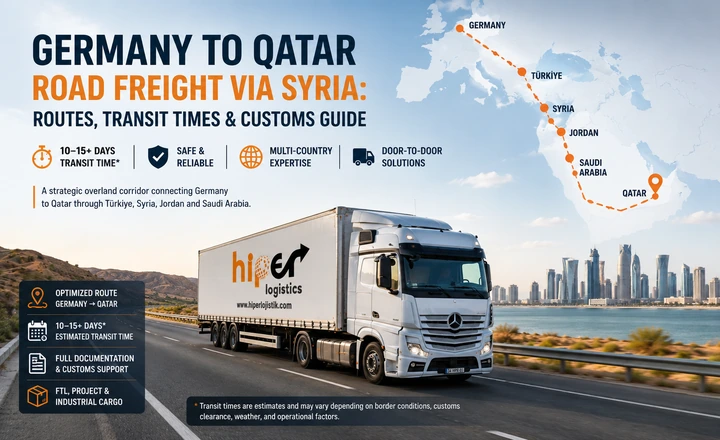
Germany to Qatar road freight via Syria provides an overland logistics connection between Central Europe and the Gulf through Germany → Türkiye → Syria → Jordan → Saudi Arabia → Qatar.
For companies shipping commercial cargo from Germany to Doha and other parts of Qatar, this corridor can provide a direct land-based alternative to conventional sea freight, particularly for FTL, time-sensitive cargo, industrial equipment, machinery, automotive parts, project cargo and commercial shipments.
The main route is:
Germany → Türkiye → Syria → Jordan → Saudi Arabia → Qatar
The final part of the journey enters Qatar through the Salwa–Abu Samra land border, Qatar’s principal road gateway for commercial road traffic from Saudi Arabia. Qatar’s Ministry of Transport identifies Abu Samra as a strategic goods corridor connecting Qatar with Saudi Arabia and the wider regional road network.
Transit time should not be treated as a single fixed number. A realistic planning window depends on the German pickup city, European driving conditions, the Türkiye–Syria border, Syrian transport regulations, the Nassib–Jaber crossing, Jordan–Saudi border procedures, Saudi transit and the Salwa–Abu Samra border.
For that reason, professional Germany-to-Qatar road freight should be planned as a complete multi-country logistics operation rather than as a simple point-to-point truck movement.
Germany to Qatar Road Freight via Syria: Route at a Glance
The strategic overland corridor is:
Germany
↓
Austria / Central Europe / Balkans
↓
Türkiye
↓
Cilvegözü–Bab al-Hawa
↓
Syria
↓
Damascus
↓
Nassib–Jaber
↓
Jordan
↓
Al-Omari / Al-Hadithah
↓
Saudi Arabia
↓
Salwa
↓
Abu Samra
↓
Qatar
↓
Doha / Industrial Area / Final Delivery
The current regional logistics picture confirms that the Cilvegözü–Bab al-Hawa Türkiye–Syria corridor is active, with an indicative lead time of around 1–2 days for the Türkiye-to-northwest-Syria section. The Nassib–Jaber Syria–Jordan corridor is also listed as active, with an indicative lead time of around two days depending on customs clearance and border congestion.
The Qatar leg then continues through Saudi Arabia to the Salwa–Abu Samra border crossing.
How Many Days Does Germany to Qatar Road Freight Take?
There is no single transit time that applies to every Germany-to-Qatar shipment.
For commercial planning, a Germany-to-Qatar road freight shipment via Syria can be evaluated within an approximate 10–15+ day operational window, depending on the German origin, border conditions, customs procedures, vehicle arrangements and whether transshipment is required.
A shipment from southern Germany will normally have a different first-leg profile from cargo collected in Hamburg, Bremen or Berlin.
The calculation should therefore be based on:
German pickup city + European transit + Türkiye–Syria border + Syrian transit + Syria–Jordan border + Jordan–Saudi transit + Saudi–Qatar border + final delivery
The 10–15+ day range is a planning framework rather than a guaranteed delivery commitment.
The Syria corridor requires additional operational flexibility because transport regulations and border arrangements can change.
Why Germany to Qatar via Syria Is Different from a Standard European Road Shipment
A Germany-to-Qatar shipment can involve at least six logistics environments:
- Germany
- European transit countries
- Türkiye
- Syria
- Jordan
- Saudi Arabia
- Qatar
That creates a fundamentally different operational structure from Germany-to-France or Germany-to-Italy road freight.
The shipment must be managed across:
- Multiple borders
- Different customs systems
- Different vehicle regulations
- Different road networks
- Transit documentation
- Potential vehicle changes
- Import clearance
- Regional security conditions
This is why route engineering is more important than simply calculating kilometers.
The Main Germany to Qatar Route via Syria
The primary route can be represented as:
Germany → Türkiye → Syria → Jordan → Saudi Arabia → Qatar
A practical route architecture is:
Germany → Austria / Balkans → Türkiye → Cilvegözü → Bab al-Hawa → Aleppo → Homs → Damascus → Nassib → Jaber → Jordan → Saudi Arabia → Salwa → Abu Samra → Doha
The exact European section depends on the pickup location.
For example:
Munich → Doha
and
Hamburg → Doha
should never automatically receive the same transit estimate.
Germany to Türkiye: The European First Leg
The first part of the journey connects Germany with Türkiye through the European road network.
Depending on the origin, the truck may move through:
- Austria
- Hungary
- Slovenia
- Croatia
- Serbia
- Bulgaria
before entering Türkiye.
The exact route is selected according to:
- Current road conditions
- Border congestion
- Vehicle restrictions
- Cargo type
- Driver schedule
- Destination requirements
For time-critical cargo, route selection should be completed before the truck is dispatched.
Türkiye to Syria: Cilvegözü–Bab al-Hawa
One of the principal road connections between Türkiye and Syria is:
Cilvegözü, Türkiye ↔ Bab al-Hawa, Syria
This crossing is strategically important for freight moving from Türkiye into northwestern Syria.
The Logistics Cluster’s May 2026 regional route assessment lists the Türkiye–Syria corridor via Cilvegözü–Bab al-Hawa as active, with an indicative 1–2 day lead time for this short-haul section.
For Germany-to-Qatar freight, this is not the entire Syria transit period. It represents the northern entry point into the Syrian road network.
What Happens Inside Syria?
Once the cargo enters Syria, Qatar-bound freight needs to continue south toward Jordan.
The strategic direction is:
Bab al-Hawa
→ Aleppo
→ Homs
→ Damascus
→ Nassib
The precise road movement depends on current operating conditions, cargo type, customs status and vehicle arrangements.
For commercial freight, the transport plan should account for the possibility of:
- Border-side procedures
- Cargo transfer
- Local transport arrangements
- Customs controls
- Vehicle restrictions
The Syrian section should therefore be confirmed immediately before loading.
Syria to Jordan: Nassib–Jaber Border
The principal road connection between Syria and Jordan is:
Nassib, Syria ↔ Jaber, Jordan
This is one of the most important border crossings for the Syria-to-Gulf road corridor.
The current Logistics Cluster route assessment lists the Jordan–Syria Nassib–Jaber corridor as active, with an indicative lead time of approximately two days depending on customs clearance and border congestion.
For Germany-to-Qatar cargo, the crossing represents the transition from the Syrian road network into Jordan.
Jordan to Saudi Arabia: Al-Omari–Al-Hadithah
After crossing into Jordan, the shipment continues south toward Saudi Arabia.
The strategic route is:
Jaber → Amman / Jordan transit network → Al-Omari → Al-Hadithah → Saudi Arabia
This stage introduces another international customs border.
Transit time can be affected by:
- Border traffic
- Customs inspection
- Transit declarations
- Driver documents
- Vehicle documentation
- Cargo classification
- Public holidays
For this reason, a delivery date should always include a realistic operational buffer.
Saudi Arabia to Qatar: Salwa–Abu Samra
After crossing Saudi Arabia, Qatar-bound cargo continues toward the final international border:
Salwa, Saudi Arabia ↔ Abu Samra, Qatar
This is the final land-border stage before entering Qatar.
Qatar’s Ministry of Transport identifies the Doha–Salwa Road–Abu Samra corridor as a strategic route for goods moving between Saudi Arabia and Qatar.
Qatar Customs also identifies Abu Samra as a land customs port, operating on a 24-hour shift system, seven days a week.
This makes Abu Samra a critical point in the Germany-to-Qatar road freight chain.
What Happens at Abu Samra Customs?
At Abu Samra, the cargo enters Qatar through the country’s land customs system.
For commercial land imports, Qatar Customs requires the applicable customs declaration and supporting documentation.
Qatar’s customs procedures specify that:
- A land cargo manifest is required for land imports.
- A packing list may be required for multiple goods.
- HS codes should be included where applicable.
- Customs declarations are submitted electronically by the importer, representative or authorized customs broker.
- Goods may be inspected according to risk-assessment criteria.
- Applicable customs duties and charges must be settled before release.
Therefore, the Qatar customs process should be prepared before the truck reaches Abu Samra.
Abu Samra to Doha
After Qatar customs clearance, the shipment can continue toward its final destination.
Typical destinations include:
- Doha
- Doha Industrial Area
- Ras Bufontas
- Logistics parks
- Warehouses
- Construction sites
- Commercial facilities
- Free-zone locations
- Industrial customers
The final delivery time depends on:
- Customs release
- Delivery address
- Vehicle type
- Delivery appointment
- Site access
- Cargo unloading requirements
Germany to Qatar Road Freight Transit Time by Origin
The German pickup city has a direct impact on the overall transit window.
| German Origin | Planning Consideration |
|---|---|
| Munich | Favorable southern Germany position |
| Stuttgart | Strong road connectivity toward Southeast Europe |
| Frankfurt | Central German origin |
| Cologne | Longer western European first leg |
| Hamburg | Longer northern European first leg |
| Berlin | Eastern Germany positioning |
| Düsseldorf | Western Germany / Benelux proximity |
These should be treated as origin categories rather than guaranteed transit times.
For an exact quotation, Hiper Logistics should calculate the route from the pickup postcode.
Germany to Doha by Truck: Example
Consider a shipment:
Pickup: Munich, Germany
Delivery: Doha, Qatar
Cargo: Industrial machinery
Transport: Dedicated FTL
The route can be structured as:
Munich
→ European transit
→ Türkiye
→ Cilvegözü
→ Bab al-Hawa
→ Syria
→ Damascus
→ Nassib
→ Jaber
→ Jordan
→ Saudi Arabia
→ Salwa
→ Abu Samra
→ Doha
The estimated delivery window should then be calculated using:
Driving time + border processing + customs + potential transshipment + operational buffer
This is substantially more accurate than quoting a fixed number based only on distance.
Why the Syria Corridor Can Be Attractive for Germany–Qatar Freight
The principal advantage is the creation of a continuous overland logistics concept between Central Europe and the Gulf.
The route:
Germany → Türkiye → Syria → Jordan → Saudi Arabia → Qatar
can reduce dependence on maritime schedules for cargo where road transport is operationally appropriate.
Potential advantages include:
- Door-to-door transportation
- Dedicated FTL
- Flexible pickup
- Direct inland delivery
- Reduced port dependency
- Faster response for urgent cargo
- Regional route flexibility
However, these advantages must always be balanced against border and regulatory conditions.
Is Germany to Qatar by Road Faster Than Sea Freight?
For suitable shipments, road freight can provide a shorter door-to-door logistics chain.
Sea freight generally introduces:
Factory pickup → European port → port handling → vessel → Gulf port → customs → inland delivery
Road freight can instead use:
Factory pickup → European road network → Türkiye → Syria → Jordan → Saudi Arabia → Qatar
The correct comparison is therefore not simply freight rate versus freight rate.
It should be:
Total logistics cost + transit time + handling + inventory cost + risk of delay
For time-sensitive industrial cargo, road freight can be commercially attractive even if its nominal freight rate is higher.
What Documents Are Required for Germany to Qatar Road Freight?
The exact documentation depends on the commodity, customs regime and route.
A typical commercial shipment may require:
- Commercial Invoice
- Packing List
- Certificate of Origin
- Export declaration
- CMR
- Transit documents
- Land cargo manifest
- Vehicle documents
- Driver documents
- Import permits where applicable
- Product certificates where applicable
- Dangerous Goods documents where applicable
Qatar Customs requires a detailed original invoice and original certificate of origin for commercial importation, while land imports require the applicable manifest and supporting documents.
Commercial Invoice Requirements for Qatar
The commercial invoice should contain sufficiently detailed information to support customs valuation and classification.
Qatar Customs guidance refers to invoice information including:
- Country of origin
- Number of packages
- Package type
- Marks and numbers
- Description of goods
- Gross and net weight
- Unit value
- Total value
- Sender
- Consignee
Where the invoice does not establish origin, an appropriate certificate or proof of origin may be required.
This is particularly important for Germany-to-Qatar shipments because documentation prepared in Germany must remain consistent throughout the transit chain.
Certificate of Origin for Qatar Imports
The Certificate of Origin establishes the origin of the goods for customs purposes.
Qatar Customs requires proof of origin for imported goods according to the applicable rules of origin and customs framework.
An electronic certificate of origin can also be accepted where it meets Qatar Customs’ verification requirements.
The origin shown on:
Commercial Invoice
Certificate of Origin
Packing List
Customs Declaration
should be consistent.
Packing List for Germany to Qatar Freight
A detailed packing list is particularly important when a shipment contains multiple packages or different products.
It should normally identify:
- Package numbers
- Description
- Quantity
- Dimensions
- Gross weight
- Net weight
- HS code where applicable
- Package type
For dangerous goods or chemical products, additional classification information may be required.
Qatar Customs specifically refers to packing lists for multiple goods and the inclusion of HS codes and international chemical/hazardous-goods codes where applicable.
CMR for Germany to Qatar Road Transport
The CMR consignment note is the principal road transport document used to record the international carriage of goods by road.
It typically identifies:
- Shipper
- Carrier
- Consignee
- Loading location
- Delivery location
- Cargo description
- Number of packages
- Weight
- Transport instructions
For a multi-country shipment, the CMR should be completed accurately and consistently with the commercial documents.
Customs Transit and Border Documentation
Germany-to-Qatar via Syria is not a simple export-import transaction.
The shipment passes through multiple transit countries.
The logistics provider must therefore determine the appropriate:
- Export declaration
- Transit declaration
- Customs guarantee
- Border manifest
- Vehicle documentation
- Import declaration
- Customs broker procedures
The exact customs transit mechanism depends on the countries and current rules applicable to the shipment.
Does the Cargo Need a TIR Carnet?
The applicability of TIR depends on the actual route, customs framework and operating arrangement.
TIR should not be assumed automatically simply because the shipment is moving internationally by truck.
The logistics provider should determine before dispatch:
Which customs transit procedure applies at each stage?
This is particularly important on a Syria corridor because regional transport regulations can differ from conventional European road freight.
Germany to Qatar Customs Process: Step by Step
A simplified customs workflow is:
Step 1 — Germany Export Customs
The exporter completes the applicable German/EU export formalities.
Step 2 — European Transit
The truck moves through the European transit countries according to the selected route.
Step 3 — Türkiye Entry and Transit
The cargo enters Türkiye and proceeds toward the Syria border under the applicable customs arrangement.
Step 4 — Syria Transit
The shipment undergoes Syrian border and transit procedures.
Step 5 — Jordan Transit
The cargo crosses the Nassib–Jaber border and continues toward Saudi Arabia.
Step 6 — Saudi Transit
The shipment crosses into Saudi Arabia and continues toward Qatar.
Step 7 — Qatar Import Customs
The cargo enters Qatar through Abu Samra and completes the applicable import customs declaration.
Step 8 — Final Delivery
After customs release, the cargo proceeds to the final consignee.
What Can Delay Germany to Qatar Road Freight?
The largest delays usually come from border operations rather than driving distance.
Common causes include:
Border Congestion
Waiting times can vary significantly.
Customs Inspection
Physical inspection can extend the transit window.
Incorrect Documents
Invoice, packing list and customs discrepancies can stop the process.
Vehicle Restrictions
Foreign trucks may be subject to country-specific rules.
Transshipment
Cargo may need to be moved between vehicles under applicable regional regulations.
Public Holidays
Germany, Türkiye, Syria, Jordan, Saudi Arabia and Qatar have different holiday calendars.
Special Cargo
Oversized, dangerous or temperature-controlled cargo may require additional permits and controls.
Why Syria Transshipment Rules Matter
One of the most important operational considerations on the Syria corridor is that the original European truck may not necessarily be able to continue unchanged through every country.
Transport arrangements can require:
- Local carrier involvement
- Border-side cargo transfer
- Vehicle substitution
- Back-to-back transportation
- Additional customs coordination
Therefore, Hiper Logistics should confirm the operating model before accepting a firm transit commitment.
This is not a weakness of the route; it is simply an important characteristic of multi-country Levant logistics.
FTL vs. LTL for Germany to Qatar
Full Truckload — FTL
FTL is generally the preferred option when:
- The shipment is time-sensitive
- Cargo requires dedicated transportation
- The cargo has high value
- Direct delivery is important
- The shipment occupies a significant portion of trailer capacity
The principal advantage is operational control.
Less Than Truckload — LTL
LTL can be more economical for smaller shipments.
However, it may involve:
- Consolidation
- Additional handling
- Hub operations
- Longer planning windows
- Additional customs coordination
For urgent Germany-to-Qatar cargo, dedicated FTL is often the more predictable option.
What Types of Cargo Can Move from Germany to Qatar via Syria?
The route can be evaluated for many commercial cargo categories, including:
- Industrial machinery
- Automotive parts
- Spare parts
- Construction materials
- Electrical equipment
- Furniture
- Commercial goods
- Factory equipment
- Exhibition cargo
- Retail products
- Project cargo
- Yacht and marine equipment
Cargo acceptance should always be checked against current route, customs and regulatory conditions.
Germany to Qatar Heavy and Oversized Transport
Oversized cargo requires a completely different planning process.
Before booking, the logistics provider should analyze:
Length + Width + Height + Weight
as well as:
- Axle load
- Trailer configuration
- Loading method
- Road restrictions
- Bridge limitations
- Border infrastructure
- Special permits
- Escort requirements
- Final delivery access
Possible equipment includes:
- Lowbed
- Flatbed
- Extendable trailer
- Mega trailer
- Special project equipment
For heavy machinery or out-of-gauge cargo, route engineering should be completed before the freight rate is finalized.
Temperature-Controlled Cargo from Germany to Qatar
Temperature-sensitive cargo requires additional controls.
The logistics plan may need:
- Reefer equipment
- Temperature monitoring
- Continuous data logging
- Border waiting-time planning
- Backup arrangements
- Special customs coordination
The longer the cargo remains in a border queue, the greater the risk to temperature-sensitive products.
Therefore, the route should only be selected after confirming the complete cold-chain strategy.
Dangerous Goods from Germany to Qatar
Dangerous goods require additional compliance.
Depending on the commodity, the shipment may require:
- ADR-compliant transport
- Dangerous Goods Declaration
- Safety Data Sheet
- Correct UN number
- Hazard classification
- Approved packaging
- Route-specific restrictions
The shipper should provide the exact commodity information before requesting a quotation.
How Hiper Logistics Plans Germany to Qatar Road Freight
Hiper Logistics should manage this corridor as a multi-stage international road freight operation.
The operational structure is:
Germany Pickup
↓
EU Transit
↓
Türkiye
↓
Cilvegözü–Bab al-Hawa
↓
Syria
↓
Damascus
↓
Nassib–Jaber
↓
Jordan
↓
Saudi Arabia
↓
Salwa
↓
Abu Samra
↓
Qatar
↓
Doha Final Delivery
Each stage requires separate monitoring.
The objective is not simply to find a truck.
The objective is to coordinate:
Vehicle + Border + Customs + Documents + Transit + Delivery
as one logistics process.
Why Route Monitoring Is Critical
A Europe-to-Qatar shipment can be delayed even when the truck is operating perfectly.
For example:
Truck arrives at border → documentation problem → customs hold → vehicle waits → delivery schedule changes.
This is why shipment monitoring should include:
- Border status
- Customs status
- Vehicle location
- Document status
- Transshipment status
- Estimated arrival
- Destination readiness
For complex international road freight, visibility is part of the service—not an optional extra.
Germany to Qatar Road Freight: Professional Transit-Time Formula
A professional transit calculation can be represented as:
Total Transit Time =
Germany → Türkiye
Türkiye → Syria
Syria Transit
Syria → Jordan
Jordan → Saudi Arabia
Saudi Arabia → Qatar
Qatar Customs
Final Delivery
Operational Buffer
This formula is more reliable than simply calculating the total road distance.
The operational buffer should reflect:
- Border congestion
- Customs inspections
- Public holidays
- Vehicle transfer
- Special permits
- Security conditions
- Documentation corrections
Germany to Qatar via Syria vs. Sea Freight
| Factor | Road via Syria | Sea Freight |
|---|---|---|
| Door-to-door capability | High | Requires inland legs |
| Route flexibility | High | Port dependent |
| Urgent cargo | Suitable | Usually slower |
| Dedicated FTL | Excellent | Container based |
| Border exposure | High | Lower inland border exposure |
| Port dependency | Low | High |
| Consolidation | Possible | Container/groupage |
| Final delivery | Direct road delivery | Requires inland transport |
The best mode depends on the cargo’s commercial priorities.
For urgent machinery or production-critical components, transit time may have a higher economic value than the lowest freight rate.
Germany to Qatar Road Freight: What Should the Shipper Prepare?
Before the truck is dispatched, the shipper should provide:
- Exact pickup address
- Exact delivery address
- Cargo description
- HS code
- Number of packages
- Dimensions
- Gross weight
- Net weight
- Stackability
- Commercial invoice
- Packing list
- Certificate of origin
- Ready date
- Required delivery date
- Dangerous Goods status
- Special handling requirements
The more accurate this information is, the more accurately the logistics provider can calculate the route and transit window.
Germany to Qatar Road Freight: Frequently Asked Questions
How long does Germany to Qatar road freight take?
A practical planning window is approximately 10–15+ days via the Syria corridor, depending on the German origin, border conditions, customs procedures, vehicle arrangements and final delivery location. This is an operational estimate, not a guaranteed transit time.
What is the route from Germany to Qatar via Syria?
The principal route is:
Germany → Türkiye → Syria → Jordan → Saudi Arabia → Qatar.
Which border connects Türkiye with Syria?
A principal commercial crossing is:
Cilvegözü–Bab al-Hawa.
The current regional Logistics Cluster assessment lists this corridor as active.
Which border connects Syria with Jordan?
The main southern crossing is:
Nassib–Jaber.
It is currently listed as an active road corridor.
How does the truck enter Qatar by road?
The final international border is:
Salwa, Saudi Arabia → Abu Samra, Qatar.
Qatar’s Ministry of Transport identifies the Abu Samra corridor as a strategic route for goods moving between Qatar and Saudi Arabia.
What documents are required for Qatar customs?
Commercial imports generally require a detailed invoice, certificate of origin and applicable land manifest and packing-list documentation. Qatar Customs may also require permits for restricted goods and may request Arabic translations of foreign documents.
Is CMR required?
For international road transport, a CMR consignment note is normally used to document the road carriage and shipment details.
Is TIR required?
The applicable customs transit system depends on the exact route and operating arrangement. TIR applicability should be confirmed before dispatch.
Can machinery be transported from Germany to Qatar via Syria?
Yes, subject to route acceptance, customs requirements, dimensions, weight and any applicable permits.
Can oversized cargo use the Syria route?
Potentially, but it requires specialist route planning, suitable equipment and permits.
Can refrigerated cargo be transported?
Potentially, provided the complete cold-chain and border strategy is confirmed before dispatch.
Is the Syria route always available?
No route should be considered permanently guaranteed. Border regulations, transport rules and regional conditions can change, so availability should be reconfirmed before every shipment.
Europe to Dubai Road Freight via Syria: How Many Days Does It Take?
Germany to Qatar Road Freight: Key Takeaways
The most important points are:
- The strategic route is Germany → Türkiye → Syria → Jordan → Saudi Arabia → Qatar.
- Cilvegözü–Bab al-Hawa is a key Türkiye–Syria crossing.
- Nassib–Jaber is the principal Syria–Jordan land connection.
- Salwa–Abu Samra is the final Saudi Arabia–Qatar land border.
- Qatar Customs requires appropriate documentation for commercial land imports, including the applicable manifest, invoice, certificate of origin and packing-list documentation.
- Transit time should be calculated from the exact German pickup city, not simply from “Germany.”
- The Syria corridor can involve vehicle, customs or transshipment considerations, so the operating model should be confirmed before dispatch.
- For time-critical cargo, FTL generally provides greater control than consolidated LTL.
- The correct freight decision should balance transit time, border risk, customs feasibility and total logistics cost.
Why Choose Hiper Logistics for Germany to Qatar Road Freight?
Germany-to-Qatar transportation through Syria requires a logistics provider that understands more than European road freight.
The operation requires knowledge of:
- Germany
- Türkiye
- Syria
- Jordan
- Saudi Arabia
- Qatar
and the border points connecting these markets.
Hiper Logistics can structure the shipment around:
European Pickup
→ Türkiye Transit
→ Cilvegözü–Bab al-Hawa
→ Syria
→ Nassib–Jaber
→ Jordan
→ Saudi Arabia
→ Salwa
→ Abu Samra
→ Qatar
→ Doha Final Delivery
The goal is to coordinate the complete transport chain from loading point to final consignee.
Final Answer: Germany to Qatar Road Freight via Syria
Germany to Qatar road freight via Syria is a multi-country overland logistics solution connecting Central Europe with the Gulf through Türkiye, Syria, Jordan and Saudi Arabia.
The core route is:
Germany → Türkiye → Syria → Jordan → Saudi Arabia → Qatar
For planning purposes, a 10–15+ day operational window can be considered for Germany-to-Qatar road freight via Syria, but the exact transit time must be calculated from the pickup city and confirmed against current border and transport conditions.
The most important border points are:
Cilvegözü–Bab al-Hawa
Nassib–Jaber
Salwa–Abu Samra
Current regional logistics data lists the Türkiye–Syria and Syria–Jordan corridors as active, while Qatar’s own transport and customs authorities confirm the strategic importance of the Abu Samra land route for commercial road traffic.
For German exporters, manufacturers and distributors, the key question is therefore not simply:
“How many days does Germany to Qatar take by truck?”
It is:
“Which Syria corridor, customs procedure and transport model will deliver the cargo to Qatar with the lowest practical transit risk?”
That is where professional route planning makes the difference.
Hiper Logistics — Germany to Qatar Road Freight
Germany → Türkiye → Syria → Jordan → Saudi Arabia → Qatar
FTL | LTL | Express Road Freight | Project Cargo | Heavy Transport | Customs Coordination
For an accurate Germany-to-Qatar quotation, provide:
Pickup City + Delivery Location + Cargo Dimensions + Weight + Commodity + Ready Date + Customs Status
Hiper Logistics can then determine the appropriate equipment, route, customs structure and realistic transit window for the shipment.
Similar Services


Comments